Showing posts with label Music. Show all posts

21.7.26

Caspar Henderson Dives Deep Into the World of Sound


A Book Of Noises: Notes on the Auraculous – Caspar Henderson (2023)


            Around eight years ago, I read and reviewed a very cool book titled “The Book of Barely Imagined Beings”, by Caspar Henderson.  Mr. Henderson explored the world of animals via the conceit of a bestiary where each chapter coincided with a letter of the alphabet, and an animal whose name begins with said letter.  It is an amazing book and one that opens the mind to the infinite variety found in the natural world around us.  Having dipped my toes into the mind of Caspar Henderson, I was very happy to find A Book of Noises while browsing the library shelves.  This wonderful book explores the vast landscape of sound, divided into chapters with titles such as Cosmophony: Sounds of Space, Geophony: Sounds of Earth, Biophony: Sounds of Life, ending with the chapter Anthropophony: Sounds of Humanity.  This is right up my alley!

            Caspar Henderson comes to the topic of sound and noise from the very best angle, that of wonder and awe.  The idea came to him after a visit to a nature preserve on the Norfolk coast where he witnessed tens of thousands of knots, a short stocky bird that migrates from the Arctic each year, flying overhead.  Within the cacophony Caspar could distinguish individual wing flaps.  He coined the term “Auraculous” to describe such experiences, the word meaning a marvel for the ear.  This is the true theme of this book.  Mr. Henderson explores the vast world of sound we live in and create and does so with a sense of poetry and beauty fitting to the magical world that sound provides to us.  As he puts it, “writing this book has been an attempt to listen more deeply and hold on to a sense of aliveness, in which each moment is a validation of what came before and a preparation for what comes after.”  We live out our lives ignoring most of the aural sensory input around us, much to our detriment. 

            My favorite chapter, Biophony: The Sounds of Life, explores the aural world of our plant and animal brethren.  I enjoyed reading about the various sounds plants make, many of which our modern ears just ignore.  One of the old Buddhist koans, meant to encourage introspection, famously reads, “If a tree falls in the woods, and no one is there to hear it, does it make a sound?”  I have always found this inane.  Of course it makes a sound.  Sound exists whether anything “hears’ it.  Sound is merely the vibration of the gas, liquid, and solid matter of the world.  Sound existed on Earth far longer than life has been around and will continue to do so long after humans reach extinction.  Only the inflated egocentrism of humans (which I think is the REAL lesson behind the koan) allows us to imagine ourselves as the primal source of experience in the world.  What a disservice this is to our fellow living beings.

            Caspar Henderson uses the last chapter of this book for an exploration of the many sounds created by humanity, from onomatopoeia and musical instruments to noise pollution, and even to a rumination on silence itself.  In this chapter Mr. Henderson extrapolates the future of man-made sound, including the ability to utilize sound for healing as well as for weaponry.  As with anything in the world, whether it is used for good or evil is dependent on the human making the decision.  Sound can heal and it can harm, therefore it is up to us to determine how best to use it to improve not only humanity but the beautiful and varied world around us.  The path towards good or towards evil is one we embark on in our hearts and minds, way before any action comes.  Books such as these help us maintain our proper distance from our own ego and allow us to replace ignorance and supposition with facts and logic.  Caspar Henderson does us all a great service through his writing.  I have now read two of his works and will look forward eagerly to the next one!  To Mr. Henderson, and everyone reading this who loves to search for the Auraculous, I sign off with the rejoinder made famous on the now-defunct Sonic Youth Gossip Forum, which exhorts the recipient to live a “Sonic Life!”

 (This great book can be purchased here: https://press.uchicago.edu/ucp/books/book/chicago/B/bo200525016.html )

21.3.25

An Overheard Conversation Leads to a Fabulous Book Detailing Postpunk Music and Times


Rip It Up and Start Again: Postpunk 1978-1984 – Simon Reynolds (2005)


             Yes!  Once again, a recommendation from a Library patron turns out to be amazing.  Overhearing a discussion between our Librarian and the patron in question, the words “Rip It Up and Start Again” rang in my ears.  I interrupted them to ask if the book had any relation to the Orange Juice song, which, by fortuitous occurrence, I had just listened to on my daily post-lunch walk around campus.  The patron stated that, yes, the books title was taken from the Orange Juice track, and that the book was a history of postpunk music, well-worth reading.  After a quick request through the Inter-Library Loan program, the book was in my hands days later.

            As a devoted music fan, specifically of the more subversive and transgressive music from the 80’s and 90’s, I had read plenty on the Punk revolution of 1977, and of all the progenitors to that scene, artists such as the Velvet Underground, The Stooges, The Ramones, etc.  While people to this day play and perform “punk” rock music of all types, the initial incandescence of Punk was extremely short-lived.  Between 1976 and 1978, the Punk scene rose and died, mainly in the UK.  The ideals of a return to simplicity, to the feel and vibes of the initial rock legends everyone idolized, were a reaction to the inherently bloated and self-important nature of what was seen as rock music in the 70’s.  The rise of anemic, glossy, adult-oriented “rock” coincided with an explosion in the complex, obtuse, and difficult music or “progressive rock” and the inflation of the rock superstar mentality.  This led to the seemingly-regressive ideals of punk rock.  It was no longer important to be a trained, expert musician, or to pose as an “artist” creating important music. 

            The initial death of Punk coincided with its appropriation by the record companies seeking new money-making material.  Most of the early punk bands self-released their music, which sold well enough, but once the fad of “punk” hit the suburbs, the record companies sought to cash in.  In the aftermath of all this, a new crop of bands appeared, seeking to move forward, not backwards, and to seek new ways of making music more resonant with their modern world than the throwback Punk music of the previous few years.  To them, the retro-worshipping stance of the early punks was invalid, for in seeking to make the sounds of the future they simply reiterated the initial rock sounds of the past.

            The 7-year period covered in this book was one of infinite creativity, cynicism, and wild musical exploration.  The adoption of synthesizers, the refutation of the standard bass, drums, and guitar set-up, and the plunge into atonality all contributed to create wholly new music.  Although I was too young to experience most of it, many of my favorite acts were heavily influenced by the postpunk bands.  Groups such as Sonic Youth, The Butthole Surfers, and Big Black were my bread and butter.  Reading about the bands and times that influenced them helped me understand my faves more.

            Books such as this one provide first-hand context for the bands and music of this time.  They also help shine a light on bands that otherwise would stay vague memories in fans minds.  I learned a lot about bands such as The Fall, KLF, Scritti Politti, The Mekons, and others whose records I had seen, or whose music I had heard praised by the bands I like, but have never explored sonically.  I also learned many new things about bands I have loved for years, such as Public Image Limited, Suicide, and the aforementioned Orange Juice. 

Much like the experience of reading Thurston Moore’s “Sonic Life,” this book transported me to a world I have only seen referred to or mentioned tangentially.  The bands and music scenes detailed within ‘Rip It Up and Start Again” attempted something original, to try and create new music without the oversight and control offered by the record companies, music attempting something new and modern.  It was these bands, not the punk bands, that paved the way for the DIY and independent music scenes of the 1980’s in the USA and UK, allowing home-grown networks of promoters, clubs, record labels, and independent bands to travel the country and answer to no one but themselves.  Too often, artists who do not make it into the mainstream culture are forgotten, and their contributions are ignored, or bypassed in favor of the cleaner, generic acts that normally populate the charts.  Simon Reynolds has done all music fans a great service by writing this book.  Highly Recommended.

(This book can be purchased here: https://www.penguinrandomhouse.com/books/291130/rip-it-up-and-start-again-by-simon-reynolds/ )

7.2.24

Thurston Moore's SONIC LIFE Became My Sonic Life


Sonic Life: a Memoir - Thurston Moore (2023)


I am a Sonic Lifer. In my heart, I truly came into my own when I first heard the sound of Sonic Youth's "Daydream Nation" at age 16.  I had finally discovered an aural equivalent to the skronk in my own head.  There was no turning back.  While Sonic Youth was not the first band I rocked to, or first loved, or first thought of as "my fave," they were the band that crystallized me.  Because of this I hold them, their music, and the individual members in very high regard.  

When the inevitable happened, and Sonic Youth ceased operations as the premier skronk-machine live act around, I accepted it, and thanked them for the long musical ride.  Not many bands can continue to make new, interesting, challenging music for nearly thirty years.  In 2015, Kim Gordon published a wonderful book, "Girl in a Band." Part memoir of her formative years growing up in California and the fine art world, and part personal air-clearing about the break-up of her marriage.  After decades of fandom, I was allowed a peek into the mind of someone I had both idolized and adored.  It was as beautifully written and insightful as the Artforum essays she wrote in her early life.  

Many people thought Thurston would write his own version of the events, because that is what a public wants to see, the airing of grievances.  Instead, Thurston Moore wrote this memoir to his first and one true love, loud rock music, and the thrills of a truly transcendent performance.  

Thurston begins with his older brother playing "Louie Louie" over and over on a scratchy vinyl single.  This resonated with me deeply.  As a child who started paying attention to bands and music in 1981, I grew up in a house surrounded by music, stereos, 8-Track players, turntables, etc.  Music was of primal importance in our house.  My mother's oldies station would play some songs that I just loved, including 'Louie Louie."  I was always attracted to the wilder, more propulsive oldies.  I liked things that rocked and began looking for such music.

Thurston Moore was such a teenager, always searching for new sounds, driving to NYC with a friend to explore the record stores, eventually spending weekends in the city seeing shows and buying used books.  He found himself drawn to the seedy lower east side and the Bowery, areas where the fringe bands could perform, and where an underage kid could sneak in if he arrived to the show early enough (a method I also employed at various Houston area venues.)  It was at such a show that he witnessed an early performance by the duo Suicide, one of the fiercest, most transgressive acts ever to come out of the NY scene.  Thurston had a front-row seat to something completely new, what became the No Wave scene.  Bands such as Suicide, Teenage Jesus & The Jerks, and others forged a separate sub-underground for themselves where the musical goal was not to craft songs, but to destroy the very foundation of song structure and performance.  

Apart from No Wave, the avant-garde music coming from people such as Rhys Chatham and Glenn Branca, stylistic innovators and sonic risk takers, also shaped and forged Thurston's musical sensibility.  Throw in a healthy dash of hardcore punk and a deep love for the absurd, and you have what Thurston brought to Sonic Youth.  

Those looking for a deep dive into Sonic Youth themselves and the workings of the band will need to wait for a different book, yet to be written.  This is a tale about one person's inner musical life, and the many people he meets.  Thurston is a music fan, first and foremost.  His life outside of performing music appears to be spent looking for old records, books, and poetry ephemera.  His interactions with the fellow musicians he befriends are recorded faithfully, and it is amazing how much Thurston can remember, not just about a person, but about the bands they were in, the music they released, etc.

As a Sonic Youth fan, part of my joy came from discovering new music through Thurston.  He was always careful to select opening acts that would challenge the typical Sonic Youth audience, who, although normally open minded, had aged along with the band.  In the late 1990's, as most of the band reached their 40's, many acts 20-years younger gained wider exposure through their association with Sonic Youth.  I was fortunate to attend a 1992 concert where Houston's Pain Teens opened up, followed by a very early iteration of Pavement (3 guys, including the OG drummer doing handstands between songs).  It was amazing.

Many memoirs are either hyper focused on a few short years of an otherwise boring life, or they seek to pack every detail and aspect of a human's life into one hasty, and unsatisfying tale.  Thurston Moore has written a specific, informative, moving tribute to his life in music, and the glories he found within it.  These are not the glories of an international superstar such as Gene Simmons or Taylor Swift.  They are the glories of a man whose preferred state of being is attending an intimate performance, talking to musicians and fellow artists, and experiencing the bliss of a great show.  In this respect, Thurston is a truly blessed and fortunate man.  He has lived the sonic life many dream of, and provided that very same to his fans.  Few people are so lucky.  I highly recommend this book.


(I must give a shout-out to the always-wonderful Brazos Bookstore in Houston, Texas, where I found this book, a signed first edition, and the last one they had in stock. My wife and I were out about town, seeking a nice day after a sequence of unfortunate occurrences, and the good people of Brazos Bookstore helped us start off right.  Brazos is a haven for anyone seeking to explore the current landscape of literature.  The staff work like curators at a museum, and the selection of books is exemplary.  Books for all ages, all subjects, and all manner of curiosity.  It is a beautiful place. - RXTT)


(Sonic Life can be purchased here: https://www.penguinrandomhouse.com/books/706260/sonic-life-by-thurston-moore/ )


13.5.19

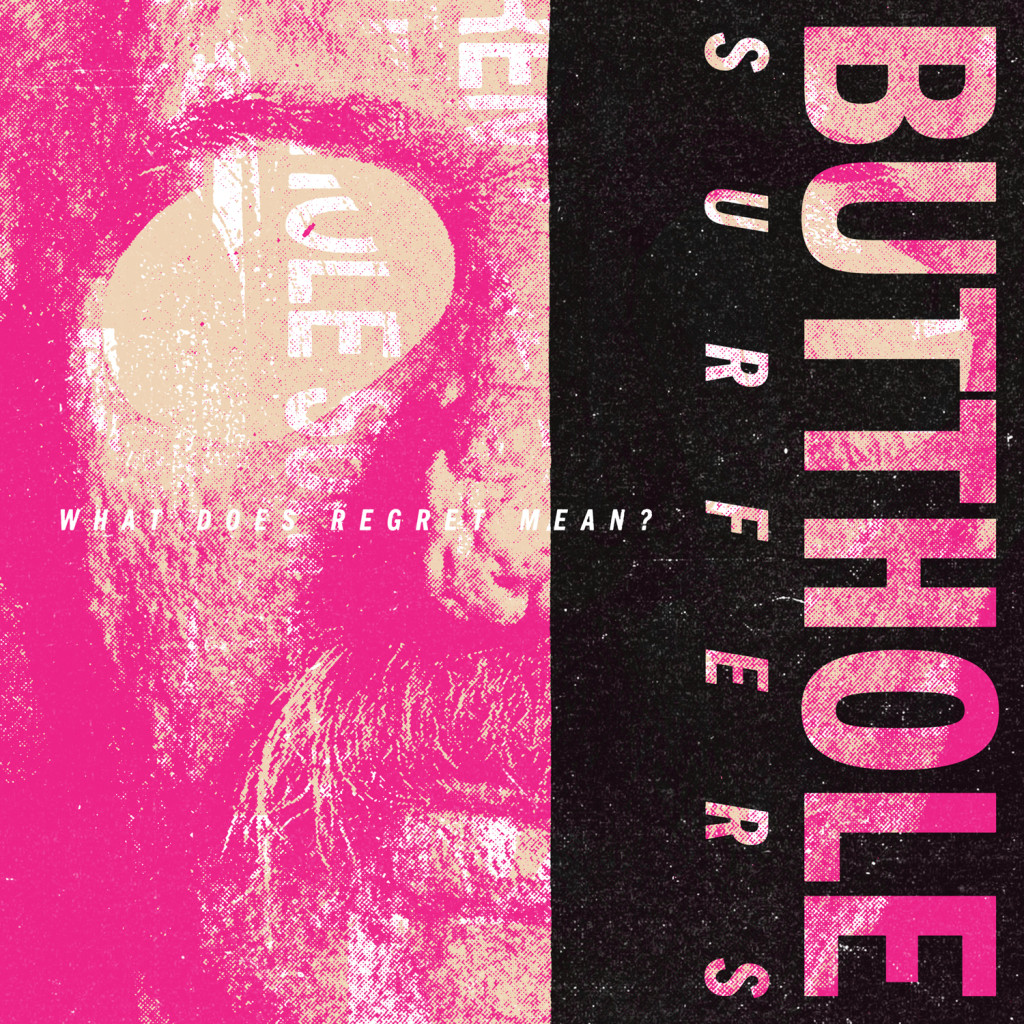
The Butthole Surfers Regret Not Regretting Anything


Butthole Surfers: What Does Regret Mean? – Aaron Tanner (2019)

            As a teenager, bored with hard rock and heavy metal for the most part, I sought out music that scared and excited and confused me because I was just so sick of the crap that MTV, radio, and the “norms” thought was good music.  I wanted the transgressive, the avant-garde, music that is so fresh and new and different that most people would hate it for years, until their feeble ears and brains could slowly catch up.  The first bands that sent me down this awesome spiral of skronk and freak-out were Jane’s Addiction and Sonic Youth.  Both were loud, rocking, and aggressive in completely different ways, and both sounded nothing like the formulaic heavy metal and thrash that had been rattling in my ears.  One band that was always mentioned alongside these two faves of mine was the Butthole Surfers.  

           My friends and I would drive into town in one of our parent’s cars on a Saturday and hit up the cool record stores.  At Sound Exchange, I would peruse the used cassette section, and every time I picked up one of the Butthole Surfers' albums, I would get a queasy feeling based purely on the visual aesthetic of their releases.  It was just SO WEIRD.  They did not list the band member’s names or song titles all that often, but what I did see is still burned into my mind.  I was too young and naĂŻve to understand that an artist’s image is mostly a fabrication.  I was also too young and naĂŻve to understand that the Butthole Surfer’s image was not in the least a fabrication, and that they were fully the weirdest single group of musicians I would ever have the fortune to listen to and love.

            Sometime in my first year of study at the University of Houston, my friend Barnaby Struve kept playing Butthole Surfers vinyl for me.  At one point he made me a 120 minute compilation cassette (remember when you could record 60 minutes of music on each side of a Memorex cassette?) of what he described as “the choice cuts.”  It was a revelation.  Even without any of the art, liner notes, or bizarre imagery, the music itself blew my teeny little mind.  I grew to LOVE these songs, to understand and relate to the insanity within, to see the undeniable beauty contained within, and to appreciate the balls it took for this band to stay true to their demented idea of themselves.  I played that cassette so many times.  I dubbed it for at least 5 different friends.  At parties, I would commandeer the stereo and play this Butthole Surfers compilation repeatedly (some people were not too happy about this).  The music was like instant intoxication, if that intoxication actually exposed the ugliest sides of ourselves.

            That was in 1991-1994.  The Butthole Surfers had been taking cares biz-nass since 1981.  Never during that time period would anyone even remotely aware of the Butthole Surfers consider that in 2019 a lavish, expensive, and downright beautiful coffee table art book would be released based mostly on the imagery the Butthole Surfers used in the promotional material, records, and merchandise.  Before the internet, the main way you found out about bands was from word-of-mouth, or lucking into seeing them as they opened up for someone you liked, or seeing a cool t-shirt on someone and striking up a conversation.  The Butthole Surfers were a band whose fandom grew in this manner, because everyone that witnessed a live show could not stop talking about it.  There was no other band like them.  There will never be another band like them.

            This book is like a deep time-slip dive into our collective Butthole Surfer past.  I cannot emphasize how often my shit-eating grin would appear on my face as I read this book.  Whether this was because of the many amazing images and fliers and promo materials, all presented like a DIY ‘zine, or because the commentary and remembrances sprinkled throughout brought me back to those times.  I was too young to see the Buttholes perform their insanity at small clubs in Texas, but I did get to see them perform many times, including at Lollapalooza where singer Gibby Haynes used a shotgun loaded with blanks to shoot at the crowd.  That shit was scary.  This book is scary.  The Butthole Surfers are scary.  They have to be.  I would not have it any other way.

            Aaron Tanner’s goal with this book was not to write a history, even though it is constructed sequentially.  He sought to share with the world just how individual and amazing the visual component of the Butthole Surfers’ myth was, from promo materials, to zines, to album notes, and personal photographs.  He has created something that I will treasure all the days of my life.  To top it all off, a flexi-disc is included with the book, containing a track that was to be used as a B-Side during the Independent Worm Saloon era.  Such cool stuff.  For a die-hard fanatic like myself, it is pure joy.

(BTW, I have played my wife 5 different Butthole Surfers songs over the past 8 or so years.  Each and every time she hears a new one, she tells me that it is "the single worst song she has ever heard."  This makes me laugh with glee and appreciation.)

(The Regular edition is sold out.  The Deluxe Edition is still available here: Melodic Virtue )

14.11.18

Sonic Youth is Dead. Long Live Sonic Youth.


Spirit Desire – Jennifer Benningfield (2018)

            I am a Sonic Youth Lifer.  The skronkalicious foursome has been my favorite musical group for the past 30+ years.  As a part of my fandom, I have been a member of the Sonic Youth Gossip Forum for nearly the entire existence of the interwebs.  In that nebulous cul-de-sac I met and have befriended many a fellow Sonic Youth Lifer.  I have seen them grow up, rock out, and move on with their lives.  I have lost Sonic friends who passed too early (RIP Adam “atsonicpark” Cooley - http://directoradamcooley.angelfire.com/ ).  I was also exposed to some of the most creative, interesting, and downright bizarre people, all of them Sonic Youth nuts to one extent or the other.  One of these bad-asses is Jennifer Benningfield, or as she is known on the SY Gossip Forum, jennthebenn.  In 2009 she published her first book, No Setlist: Pieces of a Sonic Life, detailing her near-obsessive devotion to traveling for Sonic Youth concerts.  My review of that book is here: http://rxttbooks.blogspot.com/2017/06/rxtt-flashback-review-story-of-sonic.html .

            It is now 2018, Sonic Youth have broken up, and the individual members have moved on to new musical projects, as varied as one can imagine.  Jennifer Benningfield has released the follow-up to No Setlist.  The development of her writing voice and style are evident throughout, as the book is tighter, funnier, and in many ways more resonant than her debut.  Like before, the book is divided into sections detailing individual Sonic Youth concerts she attended, describes the moment she and her partner in crime, Patrick “pantophobia” Suddath learned of the imminent breakup of our favorite band, and finishes with her treks to various post-Sonic Youth concerts.

            If it was inspiring to me to read Ms. Benningfield’s initial love letter to the Youth, it was even more amazing to read this new book, appreciating the growth and maturity of writing that has allowed Jennifer Benningfield to submit her short stories to various hard-copy and online publications.  While I do not personally know her, having had little interaction with her besides the Sonic Youth Gossip Forum (and the Instigator Fantasy Football league which I run every year.  Jenn’s team is Snoopy’s Smash Squad, and anyone who knows her knows she has a near-fetishistic fascination with Charles Schultz and the Peanuts gang), I am so proud of this digital friend for grinding away, for continuing to write and submit, even though the rejections and tough times can seem never ending.  The band is very lucky to have someone such as her as a fan.

            One of the little oddities that I found endearing in this book, is the way that, as a super-fan, Ms. Benningfield describes the journeys taken to the shows, the people she meets and stays with, the long-distance friends she connected with, the fearful walks through unfamiliar neighborhoods in search of a pre-show meal, and everything that goes into attending rock shows.  I myself have attended countless hundreds of not thousands of rock shows, and these little details are the ones that actually make the occasions memorable, apart from the musical performances themselves.  There is a huge difference between going to a big, national touring show at a giant arena, and going to a small touring act performing at who-the-fuck-knows-where.  It is more personal, more intimate, and if you are one of the early arrivals, like Ms. Benningfield likes to be, you can be in the FRONT ROW!  (I never ever stand in the front row.  I am 6’2” tall, and no one likes my ass blocking their view.)

            Sonic Youth is no more.  The Sonic Youth Gossip Forum is creaky and increasingly less populated.  The Sonic Lifers have had to move on.  Our favorite band, the band that never even sold 250,000 copies of any release, that taught so many of us what noise as Art was, and the possibilities inherent in that, will never come together in skronk again.  All we have are our memories, and thanks to the mind and work of SY Lifers such as Jennifer Benningfield, we can all share in our collective Sonic Joy.  SONIC LIFE!

(This book can be downloaded and read here: https://trapperjennmd.blogspot.com/2018/07/spirit-desire.html)

14.3.18

Haruki Murakami and Seiji Ozawa hang out, listen to records, and talk about music.


Absolutely on Music: Conversations with Seiji Ozawa – Haruki Murakami (2016)

“Like love, there can never be too much ‘good music.’ “ - Haruki Murakami

The Japanese author Haruki Murakami has been one of my favorites ever since I first read A Wild Sheep Chase in my sophomore year of University (oh so very long ago...around 1992-1993).  I owe my love of Murakami to my man Elliott French, who loaned me his copy of that book.  I have also been aware of Maestro Seiji Ozawa’s work, as I spent 7 years playing cello in the school Symphony Orchestra.  Coupled with my father’s enjoyment of classical music at home, this left me with a life-long love of classical symphonic and chamber music.  When I read that Haruki Murakami’s newest book was to focus on conversations between these two giants, and their shared love of music, I grew restless to read it.  Thank Mario for the University of Houston’s M.D. Anderson Library and the bad-ass librarians there who keep the shelves full of fresh new books!

Previously on this Intellectual Journey, I had the chance to read and write about Haruki Murakami’s first non-fiction book, the moving and shocking Underground: The Tokyo Gas Attack and the Japanese Psyche.  Where that book delved into a tragedy that shook a nation to its core, and the after-effects of it all, this book is a joyous celebration in many respects.  Murakami has been a life-long fan of music, with a deep knowledge of Jazz and Classical music.  Ozawa has been working as a conductor since the 1960’s, where he was Leonard Bernstein’s principal assistant.  He was barely 30 years old, knew very little English, and eventually studied and worked under the tutelage of some of the greatest conductors of the 20th century.  Both of these men have very strong opinions and ideas about music, but since one is a music creator and the other is a music aficionado, there is no rancor in any of their conversations, only mutual admiration and the joined love of good music.

The interviews recorded here were conducted over the course of several years, and include the time period when Maestro Seiji Ozawa suffered from a debilitating condition which required surgery and left him unable to conduct what was usually a quite frenzied schedule.  Through the course of these meetings, Murakami would pull out music from his vast collection of records and play them for the Maestro.  These included classic performances by Glenn Gould, and various world-renowned Symphony Orchestras.  Some of these were recordings of Maestro Ozawa’s performances, and others were from various contemporaries of his.  The insights that both men bring to the various recordings is just wonderful for a music nerd like me.  It is the next best thing to sitting in a room listening to music with them.  What a cream-dream that would be!

I learned quite a lot about music, about the art of conducting, about the art of teaching young students how to make good music together, and about the relationship between the conductor, the score, and the musicians that make that score come to life.   I also learned a lot about Haruki Murakami himself, and the deep musical knowledge that he has acquired over his lifetime.  Their discussions regarding the differences between a professional writer and a professional conductor make for enlightening reading.  As a writer, Murakami answers to no one, sets his own time-table, works completely alone, and keeps a very rigid schedule.  He awakens around 4 AM, writes for about 5 hours, then proceeds to go eat lunch and get on with the rest of his responsibilities.  Maestro Ozawa likewise gets up around 4 AM, but he states that he gets quite a hunger around 3 hours later, which causes him to interrupt his work.  He then spends the rest of the day in the myriad other duties of a professional conductor.  The quiet morning time is for his most difficult work, that of reading scores and understanding what the composer intended.  Murakami does not travel much due to his work, but Ozawa is all over the world, from guest conductor stints in Vienna, Berlin, Boston, etc., to his several once-a-year Orchestras that gather up players from around the world.  He has to be an organizer, a teacher, a musical genius, and above all, a leader of people.  

 While both men live in quite different worlds, their relationship only got stronger as the interviews took place.  One of the coolest things in the book is a short afterword by Seiji Ozawa where he discusses how him and Haruki met, how he grew to appreciate the talks with Haruki more and more, and how much he actually learned and remembered through the conversations.  Books like this give a great insight into the minds of genius.  I highly recommend it to anyone who loves classical music, and any fan of Haruki Murakami.  I learned a great deal.  

(On his website, Haruki Murakami lists a selection of music that he and Seiji Ozawa listened to during the course of this book’s writing, and provides links to listen to these recordings.  AWESOME.  Here is the link: http://www.harukimurakami.com/resource_category/playlist/absolutely-on-music )

(This book can be purchased here:  ABSOLUTELY ON MUSIC  )

21.6.17

*RXTT Flashback Review* The Story of a Sonic Youth Fanatic and her Adventures in Skronk


NO SETLIST: Pieces of a Sonic Life - Jenn Benningfield (2009)

(Today on RXTT's Intellectual Journey, we go back to a book review from several years ago, that I published on a different blog, -FUPPETS- , which is now-defunct.  The review has been edited slightly. - RXTT)

Long-time Sonic Youth fanatic and all around bad-ass, Jenn Benningfield, has documented her obsession with live Sonic Youth concerts, as well as the life that develops around such an obsession, in her book NO SET LIST: Pieces Of A Sonic Life.  I have absorbed the book, and what a book it is. While the omnipresent Sonic Youth are integral to the book, it is Sonic Youth's peripheral universe that is the real star here. 

The lines of uber-fans showing up hours early, the crowds of people that frequent the shows, the travel required to attend 40+ shows and the inevitable highs and lows of that travel, the camaraderie between people who are total strangers except for the fact that they love skronk rock, and most of all, the joy of the fleeting moments shared with one's musical idols, these are the main pillars of NO SET LIST. 

The bits that truly hook the reader though, are the relationships that Jenn builds with her fellow fanatics, whether at shows or through meeting those people she has corresponded with on Sonic Youth's infamous Fan Gossip Forum, including one who would become her partner-in-crime for much of NO SET LIST's duration. Her travels begin close to home but soon take her throughout the Midwest, California, Oregon, and as far as Britain in search of that sonic eargasm that only Sonic Youth can provide. Planes, trains, and automobiles are all endured, travails are overcome, and health issues are faced, all with humor and biting wit, and with the help of Snoopy's all-consuming love. What could easily become rote, (the endless bus/train stations, the countless opening acts, the obsession with Sonic Youth), never does and this is a testament to the quality of the writing within, not to mention the quality of the mind making the observations which we are absorbing. 

Sonic Youth is not an "easy" band to like. They go out of their way to test and expand their audience's ears. They are a group that seeks to make art, and that seek to push the envelope as to what can constitute great musical art. Jenn captures all of this, as well as the blinding white skronk joy that Sonic Youth give to those that are patient and keep their ears open. NO SET LIST opens this world and exposes it to the light. What we find inside is comforting, exhausting, exhilarating, and downright beautiful. I wish Jenn was put on retainer by Sonic Youth so as to document their every appearance! That way, I would have a mainline to the world's greatest band, and there is nothing better. I would like to thank Jenn Benningfield for writing NO SET LIST, and for having the balls to put herself and her writing out into the world.

(This book is currently out of print)

17.4.17

The Usefulness of Useless Knowledge


The Usefulness of Useless Knowledge – Abraham Flexner (1939)

            One of the most disheartening developments in education in my lifetime has been the emphasis placed on teaching students only the knowledge and subjects that have practical, or “useful,” content.  Every year more and more people want their kids to study only the fields in which a great salary is guaranteed.  Learning for learning’s sake is frowned upon by helicopter parents who push their kids to fit a predetermined mold.  This is a huge disservice to the students.  One of the greatest advantages of a University education used to be that you learned how to educate yourself for the rest of your life.  This was what a well-rounded education was to provide.  Critical thinking skills, deep curiosity about the world, a variety of experience and wisdom from a wide field of human intellectual endeavors, and the ability to be a well-rounded adult were all worthy goals in and of themselves, without regard to future employ-ability or salary.  It is quite eye-opening to read Abraham Flexner’s essay from a 1939 issue of Harpers Magazine.  He was confronted by the same problem 80 years ago. 

            I have never read a better argument for letting students, artists, researchers, and scientists explore anything and everything that may cross their minds, regardless of whether it applies to their respective titles or fields of study.  Mr. Flexner explores the many fields deemed “useless” and finds that in each and every case, these useless ideas or curiosities either contribute greatly to the well-being of humanity as a whole (as in the case of the arts, music, and literature) or they end up adding another piece of knowledge to the vast amount collectively gathered by humanity, to be filed away until some other curious person finds it and uses that knowledge to create a new mechanism, or technology, or even just a new use for something already existing.  There is no way to determine what field of study will lead to something “useful,” which is the whole reason that nothing a human is curious about is actually “useless.”

            Mr. Flexner provides examples from various fields, each a seemingly unimportant exploration by a human mind that turns out to shine a light on a previously unknown corner of knowledge.  He cites the then very current issues arising from totalitarian fascist states in Germany and Italy curtailing “frivolous sciences” and “useless” explorations.  This led to many of the most genius humans on the planet to make their way to the United States, where they could join places like the Institute for Advanced Study at Princeton.  This institute was solely dedicated to the search for knowledge and had such a minimal infrastructure that any one person could cooperate and learn from any other, allowing geniuses in science and the humanities to explore wherever their curiosity led them.  Learning itself is what was cultivated.

            I have always been intellectually curious about nearly everything in the world around me.  There are many people who think that specialization is the true mark of genius or dedication, or intellectual rigor.  These people, while they may achieve much, are missing out on the whole picture.  I personally am an artist.  I paint and draw and I love to study art.  I am also a hardcore music fanatic.  These two fields are not mutually exclusive to most people.  I am also a deep, deep lover of all things scientific, especially the field and history of Physics.  In this case, countless people cannot fathom that a human can be artistically inclined and scientifically inclined and enjoy both equally.  I feel that, beyond the pure joy of learning itself, my scientific knowledge informs my art, and my art knowledge informs my scientific curiosities.  I am also a hardcore sports fanatic, especially my beloved American Football and all my Houston, Texas sports teams.  I have been ridiculed by sports people who do not think I am a “true fan” because art is not for jocks, and I have been ridiculed by the arts crowds for showing up to a gallery wearing a Texans jersey.  These close-minded fools will never understand, and they will never learn, until they decide to explore what intrigues them without the fear of ridicule by the people in your chosen peer group.  If only this great essay by Mr. Abraham Flexner was required reading in the schools.  Share it with someone that has been stifled in their curiosity.   It may change a life.

(This essay can be downloaded in PDF format from Harpers Magazine here: https://library.ias.edu/files/UsefulnessHarpers.pdf )