Showing posts with label information. Show all posts

12.5.25

Fred Gettings Gives us Eyes to See and Ears to Hear


 The Occult in Art – Fred Gettings (1978)


            “Occultism is the study of the spiritual world which is hidden from ordinary vision.  The word itself is derived from the Latin occulta, ‘hidden things’, and implies that the visible world is not the only one of importance to man.”

            Thus begins the most enlightening and insightful book on the occult images and ideas hidden in classical art I have ever come across.  This Library I work for is a GOLD MINE!  Born in 1937, Fred Gettings wrote extensively on occult and symbological matters, publishing many works before his death in 2013.  This book deals specifically with artists who embedded hidden imagery or knowledge within their artwork, and how to best “read” these works to understand the occult information conveyed within.

            First, I must define the “Occult” and what it means in this context.  As stated in the quote above, occult knowledge just means hidden knowledge.  Too many people buy into the lie told by christian leaders that occult knowledge is inherently evil, or satanic.  This is how they scare the deluded idiots into not asking questions or making their own decisions.  For example, when telling very young children about procreation, the story of the stork is often used.  This story occults the true process of procreation (carnal fornication, male ejaculation inside the female, and the coming together of two zygotes to form a living cell, which then splits and splits, cells differentiating, until a baby is popped out the vaginal tube, ready to breathe the good air of this world), replacing it with an inert and inoffensive tale of a stork that delivers all new babies to their mothers.  Until the child grows up and is taught, or discovers, the actual truth of procreation that knowledge is willfully occulted.  The reality has been hidden from children for their own good, or so many parents used to think.  This is also how religious and political leaders think of the great unwashed masses of humans outside their castles, temples, and private mansions.

            Fred Gettings was exasperated with the state of art criticism and art history at the time of his writing this work.  He was adamant that to understand the art of the past, historians and critics must take into account the intended purposes and meanings portrayed in the art itself, many of which related to the occulted knowledge shared by mystery schools, secret religious orders, and others who seek to retain and disseminate these ancient ideas.  Gettings’ complaints about art critics and historians still ring true today.  Too many art critics analyze work from the past through a very modern lens, one that places importance on modern artistic ideals, instead of the ideals of the artists in question.

            For example, one may view a 300-year-old painting of the crucifixion, which, through modern eyes and ideas, can be analyzed structurally, compositionally, and emotionally.  It is a valid form of criticism, but it leaves out the most important part of the artwork, the theme and subject, as well as the artist’s personal connection to the image he or she created.  William Blake was a well-known mystic and weirdo, yet many of the modern analysis and critiques of his work ignore that most salient point.  Each of Blake’s artworks come from a place of deep wonder and exploration into the metaphysical and spiritual inner mind of man.  In order to share those ideas in a visual medium, new symbols and metaphors must be created.  These symbols and the compositional elements are what Fred Gettings masterfully describes.

            Occult knowledge has a deep human past.  Initially drawn from the ancient Mystery schools that kept the advanced knowledge of our world and universe secret and safe amongst chosen initiates and away from the ignorant and violent masses, this knowledge has reached our modern world, surviving the past two thousand years of omnipresent suppression by the Catholic Church.  Many of the early christians had deeply symbolic and mythical ideas about the trinity, the divinity of Jesus, and the role of man in the cosmos.  It is man’s place in the world that many of the artists in this book analyze and explore.  Because of this, great insight is gained into the work of William Blake, Max Ernst, Wassily Kandinsky, Piet Mondrian, and other masters.  It is impressive how occult knowledge influenced the creation of abstract art, something modern critics fail to recognize, even as it stares them in the face.

            The main way to maintain occult knowledge and to share it with subsequent generations is through architecture.  It lasts much longer than written texts, or painted images.  The modern fraternal organization of Freemasonry is one of the descendants, at least in spirit, of the early secret societies.  During the first thousand years of organized christianity the builders of the churches designed and decorated them with many occult symbols and ideas.  If the wisdom is displayed in stone, it is available to any and all, even the illiterate and uneducated.  Including esoteric teachings and wisdom in images and architectural details ensured that only those “with eyes to see and ears to hear” understood the message, preserving the hidden knowledge from those that seek to destroy it, namely, the catholic church that styles itself as the supreme arbiter of what is real, important, christian, holy, etc. 

Fred Gettings is clear and concise in his explanations, and astute in his observations.  His attempt to share the hidden world of art serves to expand the mind, and open it up to new ways of seeing, of learning, and of understanding the artistic creations of our ancestors.  I look forward to digging up some more of Mr. Gettings insightful books, and sharing my thoughts about them with my readers.

8.2.23

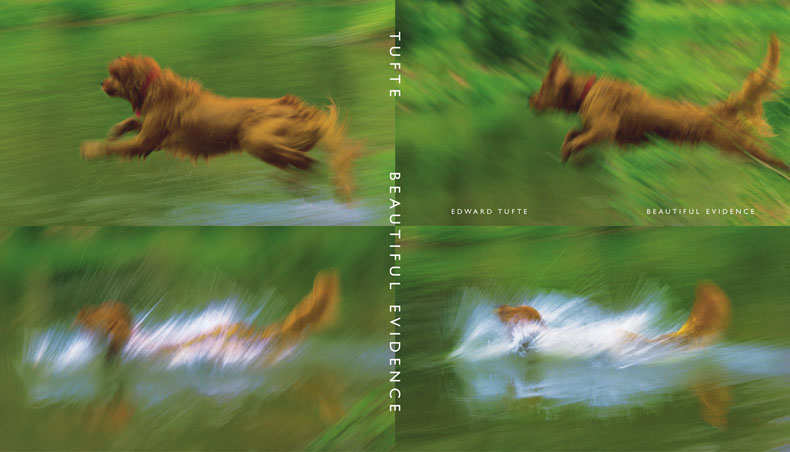
Edward Tufte Shows Us How to Properly Share Data That Combines Text, Numbers, and Images


Beautiful Evidence – Edward Tufte (2006)


            Sometimes the book lords look down upon us lowly humans and grace us with tomes we would otherwise not read or know about.  Such was the day I found this amazing work by professor, author, and sculptor, Edward Tufte.  As one of my co-workers cleaned out her office, she stacked a bunch of books aside for anyone who wanted them.  I grabbed three that caught my eye, and immediately began devouring Edward Tufte’s masterpiece.

            The introduction to this work explains Tufte’s focus, the intersection of science and art, specifically as it relates to the dissemination or presentation of raw data.  One of the thoughts in his Introduction really hit home for me, “Making an evidence presentation is a moral act as well as an intellectual activity.”  This goes for the consumers of these presentations as well.  One must be ready, when faced with a presentation of evidence, to think and judge not only what data they discuss but also how they present it.  This analytical thinking is crucial to the proper dissemination of knowledge in our data-packed world.

            Tufte begins his exploration of this subject by focusing on what he calls “Mapped Pictures: Images as Evidence and Explanation.”  He, much like I do, deplores the out-of-context images used by periodicals when writing about scientific subjects. An example of a well-mapped image is the type used in visual catalogues of flora and fauna, where, for example, the fish in question is portrayed in both profile and overhead views, which provides much more data than a single image.  Those images may also contain data about the subject, such as the length of the fish, the coloring of the fish, the species’ Latin name, etc.  Many of these animal catalogues fail to provide much data, apart from the image of the animal itself.  This is a disservice, both to the scientists that catalogued the animals, and to the reader wishing to encounter useful and correct information about them.

            Tufte provides beautiful examples of many types of mapped picture, from images detailing which stars make up the constellations in the sky, to diagrams showing the horrendous conditions that Africans were placed into by their captors who sought to pack as many onto these ships as possible.  Such an image shows not only the extent of the horror, but specific details of the horror, allowing the reader to grasp a far bigger idea than just the image itself.

            The author analyzes other methods of information exchange.  From sparklines (a graphic showing a change in value over time, such as a line graph representing the temperature in a given city over a month) to word and arrow diagrams (such as a family tree, or an evolutionary line), each is discussed at length.  Mr. Tufte seeks to show the best possible ways to convey information, keeping in mind each method’s weaknesses and strengths.

            In the chapter on the confluence of words, numbers, and images, Tufte’s first example is from the genius of Leonardo da Vinci.  In his countless notebooks, where he wrote and drew about his constant explorations, vivid drawings live right next to explanatory text and data in number form.   The ability to combine all three into a work so profound shows the reasoning and ability of da Vinci’s deep skill.  As Tufte proclaims, it is a shame that more scientists have not taken up the model provided by Leonardo.

            Another aspect of publishing that upsets Tufte, for it derails the hard work of the scientists, is what happens when publishers create new editions of classic books.  For some reason, the editors feel they need to re-arrange the layouts of the books, shifting all the text into one section, and placing the images in another.  When the purpose of the book is to educate, using words and images concurrently, such as in Galileo’s “Siderius Nuncius” (The Starry Messenger), too many publishers fail to see the importance of both text and images living side by side.  Moving images to an appendix reduces the capability of the reader to grasp what the author intends.  The worst example of this is in the editions of Isaac Newton’s “Opticks.”  Tufte shows how, from the initial pressing in London, the pertinent images were placed in a separate section from the text they belong to.  It was not until the first German edition (1898) that the images and text were fully integrated.  In 1952, the first proper printing in English occurred.  Sadly soon after four more badly edited editions would see the light of day.  As Tufte states, it is a shame that “…it took 258 years to combine word and image in the original English.”

            The latter half of this book explores the fundamental principles of analytical design, and provides some amazing examples of quality work.  The best part of the second half of the book is where Edward Tufte patiently explains the many ways that data is corrupted in evidence presentations, with the most vitriol aimed at the ubiquitous and hated Power Point software.  The damage that PP has done to professional information exchange is hard to calculate, but Mr. Tufte does a great job of explaining it.  The saddest fact I read was how, when the space shuttle Columbia accident occurred, an independent body analyzed NASA’s information exchanges, focusing on how warnings about the shuttle were ignored or avoided altogether.  The analysis showed that nearly 90% of all data shared at NASA was in the form of PP slides.  HORRENDOUS.  Tufte explains how these slides, containing minimal information, and allowing for minimal understanding, corrupt the very processes intended to inform and educate, leading to tragic errors and human suffering.

            As it should be, this book is a beautiful production.  Edward Tufte uses all of his skills and knowledge to construct a perfect blending of image, numbers, and text.  He sets a great example for anyone writing in the sciences, and anyone seeking to share information properly.  For a visually oriented person book lover like myself, this was an amazing discovery.  The book angels were looking out.  I highly recommend this book and hope it influences many to think deeper about how to portray their data, and how to engage the mind of the reader.


(This book can be purchased from the Author here: https://www.edwardtufte.com/tufte/books_be )

6.10.21

What are Words for when no one listens anymore?


The Loom of Language: An Approach to the Mastery of Many Languages – Frederick Bodmer (1914)

SUN RA Reading List


            The great Sun Ra has yet to let me down.  Previously, I ran across an article listing some of Sun Ra’s favorite books, or at least books that he felt were important to read.  The first two I read were amazing.  The first, Alexander Hislop’s TheTwo Babylons, explored the ways in which organized Christianity (the Catholic church specifically) merely redressed Babylonian “pagan” religion into a new outfit, presenting it as new and couching it in the ideas of Jesus of Nazareth. The second book I read from Sun Ra’s list was P.D. Ouspensky’s A New Model of the Universe: Principles ofthe Psychological Method in its Application to Problems of Science, Religion,and Art.  This book was even denser than the previous, as Mr. Ouspensky explored the ways in which humanity has sought to understand, and disseminate, what many see as eternal wisdoms, using modern science and psychology to dissect the paths to wisdom offered by churches, esoteric mystics, and occult organizations throughout human history.

            In many ways, this current book, The Loom of Language, is equally as broad, for it seeks to not only describe the evolution of written and spoken Language, but it also hopes to educate the reader in how best to learn foreign languages. As a bi-lingual person (Spanish / English) I know the amazing benefits of speaking/reading/writing more than one language.  Mr. Bodmer, writing in the early 1900’s, also saw this benefit.  In this attempt to create a new method of language instruction, he saw international communication as the driving force for learning new languages. Ahead of the horrors of totalitarian Europe in the 30’s and 40’s Bodmer saw the correlation between a populace that does not expose itself to its neighbors or their language, and the slide into jingoism and deluded nationalism. This is what is happening in the USA currently, where anyone speaking Spanish, a language spoken in 90% of all New World countries, is assumed by ignorant people to be a criminal, “illegal alien” or poor and uneducated.  This leads to the worst kinds of overt racism.  It is even worse for the many Americans who hail from nations other than Latin America.

            Too many people see Language as a static creation, when in fact it is an ever-evolving set of ideas.  Mr. Bodmer discusses the difference between a written language and a spoken language and how this affects how language is passed on to succeeding generations.  For example, in the Roman Empire there existed at the least two separate Latin languages.  One was the formal, codified, rigid Latin of the ruling class, religion, and the highly educated.  The other was an informal, spoken Latin, used by the masses in their day-to-day lives.  It was this informal spoken Latin that slowly morphed through time and distance into what are called the Romance Languages (Italian, French, Spanish, Portuguese, and Romanian).  Meanwhile, the Church, education, science, utilized the rigid formal Latin and politics for centuries after Rome fell.  In many parts of Europe, until the late 1800’s, university education was conducted in Latin.  Today many Roman Catholic Church services still hold Mass in Latin. (Funny aside, no one really knows how to pronounce anything in Latin, as it has been a dead language for centuries.  Even so, priests continue to vocalize what they feel is Latin-sounding pronunciations of their Mass.)

            Mr. Bodmer not only does an amazing job of describing how languages morph and evolve, he constantly provides examples and word lists to detail how linguists came to know what they know, how they connected languages that seem disparate but come from common sources, and how they are able to explore seemingly dead languages by comparison to living ones.  This is just the beginning, for the bulk of the book deals with learning the actual languages, or at least learning the tools by which a reader can begin to explore new languages.  Long chapters provide detail on the grammar of Anglo-American English.  English as we know it today is very far removed from its Teutonic roots, having absorbed words and phrases from so many languages.  French, Spanish, and Greek are among the many languages that have found their place in the English vocabulary. 

Bodmer details the many prefixes and suffixes found in English describing which ones are from what root tongue.  This mish-mash of language makes English a bit complex, as words that sound the same in the ear may mean completely different things, based on the source language.  For example, the Latin phrase “ante” means “before,” as in the words anteroom, antecedent, etc.  The Greek phrase “anti,” pronounced exactly as the Latin “ante,” means “against/not,” as in the words antipodes, antifascist, antagonist, etc.  While this makes English a tough language for a non-speaker to master, it allows an English speaker to understand foreign words much more quickly.  This may be why English has spread throughout the world as the unofficial language of international business.

The evolution of Teutonic and Romance languages is thoroughly explored.  At all turns Mr. Bodmer reiterates the need for an international language, capable of fostering communications between the people of the world.  This was his lofty goal.  It is scary to think that, just a few years later the horrors of totalitarianism, nationalism, and bigotry would turn much of the world into a war zone.  It would probably make Mr. Bodmer sick to know that, decades after surviving the cataclysm, our “leaders” continue to push our nations into authoritarian, jingoistic, nationalistic fervors.  “Us” versus “Them” is a pointless exercise, meant only to divide the people while those in power maintain their death grip on us.  Just like all human beings, all human languages, when traced back, come from the same place.  We are all together in this world, and languages add to that beauty.  It is upon each of us to try to learn more than one language, and by extension, to understand each other better.  I can see why a visionary like Sun Ra would recommend this book.  Anyone seeking to learn new languages would be well-off reading this.  We must continue to fight the good fight against willfully proud ignorance and intellectual blindness.

(This book can be read/downloaded here: https://s3.amazonaws.com/arena-attachments/255464/07f8d71c7c840bec709cf5a38e7da300.pdf )