Showing posts with label Consciousness. Show all posts

29.5.26

It appears that humanity has always ridden the Mindway in search of wisdom, insight, and community


The Routledge Companion to Ecstatic Experience in the Ancient World – Diana Stein, Sarah Kielt Costello, Karen Polinger Foster, Editors (2022)


            While I treasure and adore all books, it is books such as this one that thrill me the most because of the amazing amount of information included within.  Having read books on shamanism, ancient humans, and myth creation recently, I was thrilled when this book appeared in my hands while browsing the stacks.  The editors of this work, Diana Stein, Sarah Kielt Costello, and Karen Polinger Foster have provided the world with a magnificent resource exploring a seldom-analyzed part of our collective human past, that being the use and exploitation of what the writers term “Altered States of Consciousness,” ASC for short.  For far too long archeologists and anthropologists saw ancient man through our own modern “enlightenment” principles, ignoring all “subjective” experience such as trance, spirit possession, hallucinations, etc., in favor of empirically verifiable data.  This created a vast chasm of ignorance regarding the spiritual and mental lives of our ancestors.  It is the aim of this work to rectify that and to help guide the exploration of our distant human past towards a better understanding of the role ecstatic experiences had in the shaping of our species.  It is an impressive achievement.

            Formatted much like a textbook, each section presents a case for the omnipresence and importance of ecstatic experience in understanding the cultures of our ancient past.  The first section of three chapters, titled “Setting the Stage,” explores the history of ASC dismissal by biased researchers and explorers of our past, providing a firm foundation upon which to expand the explorations each writer takes in turn, and showing how universal these ecstatic experiences were.  These chapters also expand on what used to be the definition of “ecstasy” to include all types of societal, spiritual, and shamanic altered states of consciousness.  The third chapter of the first section aims to provide empirical models to define ritual practices and ecstatic experiences, from ancient man to today’s modern world.  It helps place these studies, and ASC’s themselves, within the greater study of humanity and its development, something which mainstream archeology and anthropology has dismissed for centuries.

            The second section seeks to elucidate the evidence we have for the various types of psychoactive compounds, plants, and substances used by our ancestors to achieve ASC states.  Evidence from archeological digs, mass-spectrometry, and other modern tools is given to show the wide variety of ingestible, smokable, or otherwise applied natural materials used in ecstatic rituals.  The full gamut of intoxicants is analyzed, from botanical specimens and residue found within sealed jars, to the early use of fermentation to create drinkable alcohol, to the various mind-altering plants used by the Babylonians, Hittites and early Egyptians, all recorded in their language and art.  To emphasize the communal use of these substances, the final chapter of section 2 discusses a type of ceramic container found throughout ancient sites.  The Ring-Kernoi is a device consisting of a ceramic tube, shaped into a donut, with four to five adorned containers attached to the ring.  Looking at these artifacts through the lens of ASC experience, the author describes their use in ritual communion.  Each adorned section contained wither a different psychoactive compound, whether opium, cannabis, mandrake, etc., meant to be smoked in sequence and passed around, or they contained different liquid substances which, when mixed up in the Ring-Kernoi, created an intoxicating brew capable of easing the passage into ecstasy.  For our ancestors, the divine, experienced through ecstatic states, was a communal activity, a very important way to define their culture and self-identity as individual groups. 

            The third section of this awesome book goes into detail exploring the numinous world of ecstatic experiences, as described by ancient humans in their own words.  Starting with a dive into the most ancient archeological sites we have found, such as Çatalhöyük, and the discovery of a communal imbibing of alcohol, whether plain or adulterated with other psychotropic substances, which took place in massive megalithic spaces, many of them underground or only accessible through narrow openings.  These are the first evidence for the types of communal, spiritual experiences out of which the human need for religious communion arose.  Delving into ancient rituals for the goddess Ishtar, the writings concerning the dead from Egypt, and the ASC’s described by the ancient residents of Crete and the Minoan civilization that followed, helps us grasp the constant flow of ideas and wisdom that propelled our humanity forward.  From these ancient civilizations we then move onto ritual experience in ancient Greece, and the various cults and oracles which took advantage of ASC’s to promote their ideology.  Ecstatic experiences were a critical part of many cults, including those of the healer Asclepius, and the gods Apollo and Dionysius. As with all roads, the section ends with an analysis of the ecstatic funeral processions recorded from ancient Rome.  These chapters help bridge the gap between our assumed knowledge of the ancients towards a more factual and historical basis, drawing from the many written records we have of Greece, Rome and their neighbors at the time.

            The final section of this great work focuses on the evidence we have from our collective past pointing to, or describing, the experiences of the “Ecstatic” mind.  This section builds on all the previous ones and shares great insights into such topics as spirit possession and prophetic ecstasy as described in Mesopotamian texts, the psychedelic art from the Aegean, and the progression from personal or communal ecstatic experience to that of rigorous, sacerdotally-dictated ASC’s utilized by the very powerful in all societies to control the masses (think of a modern Catholic service, with its rituals, chants, music, incense, and repetition, intended to draw the congregation together into a shared experience).  The insights found in these final chapters help us understand the evolution and propagation of personal ecstatic experiences into the collective religions we see all around us in our “modern” world.

            This book is a masterpiece of research and science.  I hope to see it used as a foundational text, allowing younger researchers to continue down the same path of exploration, and guiding the elders in these fields towards new ideas and possibilities for scholarship.  When we as a culture disdain “unsavory” aspects of our past, dismissing wholesale anything to do with mysticism, or our long-standing use of chemicals, fauna, trance, song, or rhythms to achieve altered states of consciousness, we negate aspects of ourselves that help us understand each other.  It creates divisiveness where these old rituals and experiences sought to create inclusivity.  It is such a shame that our modern world sees everything we do as the pinnacle of human achievement, all the while forgetting that for most of our human existence we have all had the capability of communing with the divine, of understanding ourselves and our place in the world around us, and of accepting that reality is far greater than the basic facts we all choose to agree upon.  This book is a great step in the right direction, and worthwhile reading for anyone interested in humanity’s psychological and spiritual development.


(This great resource can be purchased here: https://www.routledge.com/The-Routledge-Companion-to-Ecstatic-Experience-in-the-Ancient-World/Stein-KieltCostello-PolingerFoster/p/book/9781032108483 )

17.11.25

Julian Jaynes Has Blown My Mind Apart, and Put It All Back Together Again


The Origin of Consciousness In the Breakdown of the Bicameral Mind – Julian Jaynes (1976)


            For weeks now I have been lost in the pages of this amazing book, one which came to my attention through the bibliographies in several of my previous reads.  One of my favorite literary experiences is when I finally find a seminal book oft quoted or referenced in other books. Such a book is The Origin of Consciousness In the Breakdown of the Bicameral Mind.  Author Julian Jaynes has accomplished something outstandingly original and beautiful, providing what is perhaps the best explanation of what we modern humans call “Consciousness,” how it came to be, and how we can track that development.

            Books like this contain so much within their pages.  It is difficult enough to absorb all the information and ideas shared by the author, but discussing it intelligently is another matter entirely. In the over 11 years I have kept this book-review blog I have enjoyed countless books, but very few have coalesced knowledge and wisdom in my brain like The Origin of Consciousness in the Breakdown of the Bicameral Mind has.  It is a masterpiece of insight and research.

            Jaynes divides his work into three “books,” the first one dealing with consciousness itself, what it is, and where it comes from.  This alone is enough material for a great book.  The first great insight that the author shares involves consciousness itself.  We modern humans assume that our brains work in the same manner as all early humans.  We have an internal “I,” designating an interior head-space that exists outside of time and place, and which us modern humans see as our true selves, our internal monologue.  Jaynes central proposition is that this internal “I, this sense of individual consciousness, only arose in humanity after the invention of written language.  Before this time, humans lived in what Jaynes terms a “bicameral mind.”

            To explain what “bicameral mind” refers to, I must go into a bit of neurology and brain structure.  We humans have essentially two separate brains, connected through several channels, (the corpus-callosum is the main one, a bundle of nerves which allow signals to be sent from one brain hemisphere to the other), allowing them to communicate with each other, and to control different aspects of life.  For example, our left hemisphere contains Brocka’s and Wernicke’s areas.  These are two parts of our brain that handle language, with Brocka’s area controlling speech production, allowing our physical mouth and tongue to create meaningful words, and Wernicke’s area handling the other end of speech, that being language comprehension, the mental understanding of the auditory signals received by our ears through spoken language.  In patients who suffer from traumatic brain injuries, strokes, or other such conditions, these areas are sometimes affected, which was the initial impetus for understanding the various sections of our brain. 

            Julian Jaynes posits that, before the advent of the written word, humanity lived in a very different state of mind, the bicameral mind, a consciousness completely unaware of itself, quite the opposite of our current view of consciousness which we feel exists independently of our physical being.  For tens of thousands of years, humans lived in groups led by a “king.”  These kings dictated how the people of a said group would live. The truly great and long-lived kings would be remembered long after their death, their words still echoing in their follower’s heads.  This was not seen as an aberration.  Humans found it perfectly logical that a dead king would continue talking in their heads, as if still alive. The greater the king, the longer the voice would live on in his followers.  As evidence of this, Julian Jaynes discusses how for over ten thousand years, human burials followed the same pattern.  The deceased was not seen as dead, in the way we modern humans see things.  As long as their voice could be heard the king was alive. Because of this, the dead were buried with food, clothing, tools, and all sorts of items that would be useful to the dead person’s continuing “life.”  The high culture of the Egyptians was the pinnacle of this thinking, with Pharaohs buried alongside dozens of sacrificed slaves, wives, animals, etc.  Their isolation in northeast Africa allowed them to maintain their bicameral culture the longest, even after the advent of written language.

            Julian Jaynes posits that the first gods were the dead kings whose voices and commands could still be heard in the people’s heads.  This makes a lot of sense as ancestor worship is the oldest spiritual practice still found among us humans.  Many of the oldest tribal cultures in the world today still observe a lengthy period between when a person’s body stops breathing and when they feel the person is truly dead and ready to be buried/cremated/etc.

            This same bicameral structure is evident in Mesoamerica, where dozens of city states sprung up, flourished, and died over millennia.  These cities are all remarkably similar, containing a large central pyramid of structure housing the king, and in later times, the statue of the local god.  Everything about their lives was dictated by the king/god-king/god, and sometimes the entire city-state would revert back to the jungle after the death of a prominent king.

            Sometime around 2,500 years ago, everything changed.  In Mesopotamia, a writing system was created which altered our entire world and, according to Julian Jaynes, altered our brain’s structure.  This was cuneiform, a method of writing which involves pressing a wooden stylus into wet clay, leaving triangular marks.  Cuneiform is not a language, but a system of writing, and due to this, it was used to write down things in Assyrian, Emetic, Akkadian, and many other languages.  Essentially, once a remote king found that his proclamations could be written down and shared without him needing to personally deliver the information, he then asked his scholars to use cuneiform to write down his proclamations, history, etc.

            In this sense, writing was not what we think of today, words which, when read, create a narrative in our minds.  Much like ancient temples, statuary, and religious artifacts initially did, writing allowed ancient humans to hallucinate words and instructions, keeping the king’s voice alive well past his death.  It was an immensely valuable tool for social control in a time before individual consciousness.  For millennia, humanity passed down its accrued knowledge verbally, with specific people in each tribe/group designated to be the memory carriers, reciting long poems and stories from memory in order to share wisdom and instructions with the next generation.  These bards would not specifically memorize a text, for there was no texts back then.  What they did was remember the salient points of a tale, concerning an old god-king perhaps, and then add in connective language as they reiterated the story in question to a new audience. This way allowed the important points to be learned by the audience, while also allowing the storyteller to shape his stories, adding and subtracting parts as they saw fit to. 

            The written word changed all of this.  Julian Jaynes recounts a very dark era in the history of our developing consciousness.  The period of time, around 500-1000 years after the initial breakdown of the bicameral mind, sometime around 500 BC, was a time of dissolution, fear, and mass-violence.  Before the written language, civilizations lived near each other in relative peace, trading goods and food items, but generally just leaving each other alone.  It was understood that other human groups followed their own gods/kings, and that was good enough for them.  Once writing appeared, the “voices” of the gods/kings no longer reverberated through the people’s minds, causing chaos, and uncertainty.  The idea of an individual “I” was unnecessary before this, for everyone knew what their role was, what they were expected to do in life, and why they did it.  The god-king’s proclamations were followed without question, for he spoke directly from the gods.  The bicameral mind did not seek explanations.

            The written word quieted that internal voice that repeated the gods/kings proclamations.  City states became too large for easy control of the population.  It was at this time that specialists came into being, people whose breeding, training, or social status prepared them to be interlocutors between the god and the people.  These were the beginnings of the sacerdotal sects that we all currently deal with.  Even these methods were not enough to hold the homogeny, and the cities slowly fell into ruin and disuse, as people moved back out into the wilds to make their own lives.  Because of this, there was an extreme rise in violence and warfare.  Without the god’s voices keeping everyone safe, neighbors were seen as violent, evil, “other,” etc., and the need to exterminate them arose.  During this turbulent period, it is estimated that in both the western and eastern worlds, nearly 90% of the human population was exterminated.  This was wholesale genocide on a planetary level.  Humans are our own worst enemies.  It is a sad reminder that, even two thousand years later, our collective humanity can be quickly erased or forgotten when we end up seeing our fellow beings as less than human because they do not believe what we chose, or are told to, believe.

            Julian Jaynes traces the development of consciousness in man through our written works, the oldest ones such as the Rigveda from what is now India or the Iliad, from Greece being written at a time when the bicameral mind was still the norm among us humans.  In these tales, the human protagonists do not share their internal monologues.  They had no internal monologues.  Their actions are not self-decided.  Instead, all the actions in the Iliad, for example, are a result of a command or a suggestion by one of the many gods. Achilles does not choose his actions.  They are dictated by the gods.  The same holds for the characters in the Rigveda.  Bicameral man did not self-assess, self-doubt, or self-analyze.  He lived, breathed, and acted in accordance with the instructions provided him by the gods and spirits, voices we modern humans would describe as our internal monologue.

            In the follow-up to the Iliad, the Odyssey, the protagonists do make their own decisions.  They worry and fret and flip-flop without any certainty, something lacking in the heroes of the Iliad.  They still do not have what we would call a consciousness, however.  It is their own constituent parts that make demands.  Parts of the human, such as phrenes, nous, and psyche, were the ones dictating action.  Odysseus’ nous might demand that he feel jealousy, or his phrenes might state that the gods do not agree.  Ancient man did not think of the brain itself as the seat of our minds.  They saw different parts suited to different things.  Sometimes these would still be associated with specific gods, or spirits, but they were internal to man, not external.  Jaynes explains how today, we judge psychosomatic responses in people that would have been very familiar to the people of the Odyssey.  When we are stressed out, our stomachs feel curdled, bile rises in our throat, and we get the “butterflies.”  To ancient man, just developing the faculty of consciousness, this made sense.  When scared, our heart starts beating faster.  Our blood pressure rises.  Our skin gets cold and tight.  Ancient man saw this as evidence that the heart controlled certain emotions, much as the stomach controlled others, and the bowels controlled even others.  There is a wide gap between the mentality evident in the Odyssey and the mentality seen in the Iliad. 

            The second section of this book details the progression from the Bicameral Mind to our current consciousness, tracing the history of our gods, temples and rituals associated with bicameral thinking. Jaynes describes how Mesopotamia was the first example of modern consciousness, something which must have been very strange for those few humans who innately accepted their internal “I”.  Even the tales in Genesis describe this transition from bicameral thinking to our current sense of self.  The author traces the story from the ancient Greeks down to the nomadic tribes which were prevalent after the mass genocide period.  It was these tribes which practiced a new monotheism, replacing the pantheon of gods with one deity, and which led to our current Abrahamic religions and their strict morality, most of which is based on refuting the old bicameral gods and our ways of communicating with them.

            The last section of this masterwork seeks out the vestiges of the bicameral mind within our modern world.  Humanity went from each one of us hearing the gods’ voices directly, to the gods only speaking to select priests and oracles, and then to the gods becoming totally silent, letting their desires be known solely through omens, or the revelation of “prophets.”  Julian Jaynes backs up every one of his observations with rigorous science, and explores the role that our bicameral mind still plays in the creation of poetry, art, and music.  Many creators describe how a piece of art, or music, or poem came to them unbidden, as if the universe was speaking to them directly.  This is an example of how our two brains communicate, with one side dominant, and the other not so.  Jaynes explores hypnosis and the mechanisms used to incite it, mechanisms and techniques extremely similar to those used by ancient priests when selecting new oracles.  Basically, the less self-aware you are, the easier it is to be hypnotized.  The same goes for deeply devout religious belief. 

            This book blew me away.  I wish I could cover everything that Julian Jaynes discusses in greater detail, but that would take an entire other book!  It is a humbling thing to understand that our species, Homo Sapiens Sapiens, lived for over a hundred thousand years in the bicameral state.  It is only in the past 2,500 years that what we call human consciousness came to be.  There is no guarantee that our individual conscious selves will continue into the future.  It may be that a bicameral mind is better suited for long-term survival on Earth, and we will all soon revert back to that state.  There are no rules stating that evolution is a progressive, directional force.  Animals and plants evolve in all directions, both “forwards” and “backwards.”  It is our ego that makes us believe we are the epitome of life, that we are the best living creature created in our Universe.   That very ego may destroy us all.  I look forward to acquiring this book for my own personal library, and jumping back into its amazing pages in the future.  It is books such as this one that made me a book lover, and keep me a book lover.  What a glorious achievement.


(This book can be downloaded from the Internet Archive here: The Origin of Consciousness in the Breakdown of the Bicameral Mind - Julian Jaynes )

4.4.25

Early Humans and their Fantastic Art Help Us Understand the Rise of Human Consciousness


The Mind In the Cave: Consciousness and the Origins of Art – David Lewis-Williams (2002)


            Yet again, my employment and its proximity to amazing books yields delicious fruit.  As a sojourner into the mind and an avid reader of books studying and exploring consciousness, I am always on the look-out for seminal works in this field.  This book is one such tome.  Reading countless references to it in other works spurred me to keep a mental note, should I ever come across this book at a bookstore of library.  I was ecstatic when I saw The Mind in The Cave while perusing the shelves at my workplace.

            I first became fascinated with prehistoric art as an art and art history student.  The images ancient humans drew, painted and etched into the walls of caves are amazing and as beautiful as anything created by us in the past thousand years.  Checking out books on the art found in the caves of Lascaux and Chauvet opened my mind to the vast stretches of pre-history lost to us, and to the inherent artistic sensibilities and beautiful works of our ancient brethren.

            While the actual images and artworks created by early humans are indeed beautiful and moving, David Lewis-Williams’ focus is not on them.  Instead, the author seeks to use these early artworks to explore the how they detail the rise of what we term human consciousness.  By a careful, deliberate, and wide-ranging analysis, Lewis-Williams weaves together the story of how modern humans, Homo sapiens, developed our specific mind/consciousness, and how it differed from our nearest ancestor, Homo neanderthalensis, who co-existed with Homo sapiens for quite some time in what is now Western Europe.

            It may be hard to imagine but the uproar caused by the discovery of ancient human artworks in caves was virulent, and for a time, it stifled the proper scientific and art historical study of the cave art.  In a world where people blindly believed what con-artist priests told them, the idea that the earth was older than 6,000 years old was seen as a blasphemy of the highest order.  Everyone “knew” that god created the world, and everything on it, very recently.  They “knew” this because it was told to them as irrefutable, divinely-inspired fact.  To think this was around one hundred years ago, after Isaac Newton, Galileo and Darwin, baffles me.  The human drive to remain ignorant and accept the simplest explanation, regardless of evidence or counter-evidence, drives me insane.  It took decades for anyone to take the primitive art seriously, for, much like in today’s world, you always have idiots and the willfully ignorant railing against evidence of deep time such as fossils, claiming them to be placed in the earth by their exceedingly stupid and malevolent god to “trick” us and to “test” our faith.  What a hopeless well of stupidity.

            David Lewis-Williams describes the many ways this knowledge was resisted and ignored.  Not only did people think the artwork found in the caves could not be as old as it seemed, but they also did not wish to allow that ancient man was the equal of modern man.  Humans have an innate need to self-aggrandize, and to consider the present day to be a pinnacle of sorts.  Many people still think this way.  They truly believe that the entirety of existence, the billions of years-old Cosmos, and the near infinite expanse of galaxies around us, was created by a god whose sole purpose in doing so was forging the human race in its image. 

Another obstacle was that humans always sought a superficial understanding of things, leaving them mostly ignorant.  It is in this way that many humans at the time, and even today, inferred that what Darwin posited when he proposed Natural Selection as the means by which life evolves on Earth was that us humans are the pinnacle of evolution, that the billions of years of preparation and shifting forms of life were all in anticipation of the masterpiece that is the human race.  This is as asinine, destructive, and egotistical an idea as any created by the human race.  It is the sole basis for much of the entrenched racism found in the world, for the ignorant and self-proud racists obviously put themselves at the top of creation, closest to god, while everyone else was “obviously” beneath them.  Seemingly sensible people would expound on how the “natural order” of things meant that anyone not of pale skin was closer to the animals than to divinity.  Even in a document created by enlightened minds, such as the US Constitution, the value of a non-white male was seen as 3/5 of what a white male was.  Systematic and entrenched racism spoils much of scientific discovery and human advancement.

            Having discussed the topic at length, and how the ignorance was overcome, the author explores the differences between the artwork created by Homo neanderthalensis and that created by Homo sapiens, and how this shines a light on the rise of human consciousness.  Using the data gathered by archeologists and anthropologists, Lewis-Williams differentiates between Neanderthal and Human consciousness in a very clear manner.  While the debate concerning whether consciousness is an inherent part of life still rages, it is plain to most humans that the living creatures around us exhibit self-awareness of a sort, and awareness of their environment.  It is clear that other animals plan, strategize, and experience a wide range of emotions, just like humans do.  What is also clear from neurological and neuropathological studies is that the other consciousnesses around us lack something we humans all share.  This is the ability to “see” ourselves in a detached manner, to self-analyze, and to understand that the current moment will, if certain actions are made, lead to specific outcomes in the future.  One of the key pieces of evidence for this is that for over three hundred thousand years, Neanderthals thrived without agriculture.  The sowing, care, and harvest of plants for food and other uses requires the ability to step outside of the immediate moment, and posit a future that exists solely in the imagination.  The seasons must be considered.  The appropriate soil and needs of the crop must be noted and remembered.  This is a purely human characteristic, something lacking in the neanderthal record.  There are very few Neanderthal burials found, and they are rudimentary.  Quite a big difference from the elaborate, and ritualized human burials of early man.  Lewis-Williams posits that early man, able to step outside of his immediate mind-state to experience all the higher-consciousness effects we take for granted, began to understand that life is temporary, that the world existed before, and will continue after, we die.  Neanderthal man did not have this capability, which seems to arise from our specific neuronal structure. 

            Even in the relatively short period where Neanderthal and Homo sapiens lived alongside each other in what is now Europe, a period lasting over 20 thousand years at least, it is evident that Neanderthals did not understand their Homo sapiens neighbors.  Interbreeding happened, as is now evident by the genetic testing showing that most European people have between 1-4% neanderthal DNA in them, something that none of the human populations in Africa have.  What did not happen is the migration of ideas and knowledge.  Neanderthal tools never improved once they mingled with modern humans.  They may have seen the proto-agriculture and animal husbandry practiced by early humans, but they did not assimilate it.  They also would have seen the burial rituals of early Homo sapiens, but they never assimilated the concept.  The author’s claim is that the Neanderthal were physically unable to do so, their brain structure preventing the development of higher consciousness.

            This ability to create metaphor and symbolism led humans to explore deep, dangerous cave systems, and to leave behind the amazing artwork we are in awe of today.  While too many people try to explain and analyze these images through the prism of modern art and art theory, the author instead seeks to understand the mental state of the cave artists themselves.  In this way he explores why the art was made, and how the caves were used for ritual purposes.  One of the enlightening parts describes how the entrances of these caves, the areas that may still get some outdoor natural light, were used communally by ancient man, not as living sites or shelters, but for communal ritual purposes.  The excavation of these caves shows that while they were used repeatedly, they were never a place for habitation, apart from purely temporary use as emergency shelters.  This flies in the face of the accepted and ignorant idea of the “caveman” that suffuses modern thought.  Ancient Homo sapiens built homes and structures, just like modern humans do.  The caves were, from the start, living symbols of the cosmos, the womb of the Earth Mother, and were used by the shamans and shamanistic humans for specific ritual purposes.

            The author posits that the artwork created in these caves should be seen as the end result of the neuropsychological effects which arise in all humans through either trance, ritual, or psychoactive substances. This hypothesis fits the data we have, and avoids the pre-judged dogma that most archeologists and historians bring to the study of ancient man, which presupposes that the reasons ancient man created the artworks is of the same motivation as that of a modern human creating art.  The fallacy that the author counters forgets that the world we currently live in is an aggregate of the collective human experience, and that the making of images to a current human is filled with suggestion and analogy of which ancient man would have never conceived.  Lewis-Williams explains how the imagery, from dots, dashes, chevrons and lines, to the representations of animals, or animal “spirits,” all arise from the workings of our extremely complex neurological processes. 

For the most part, the individual artworks were created in private and remained private.  Very few humans actually ventured deep into the caves themselves, for they were and are fraught with danger.  In this manner, Lewis-Williams suggests that the creation of art was done by those either designated as or seeking to be, shamans.  The artwork was not on public view, and was never intended to be communicative.  The primitive art, consisting mainly of a specific group of deified animals (bears, bulls, ibex, horses) served the shaman’s purposes, and not the tribes.   Comparing the types of images created by our ancestors with the images seen by those who hallucinate due to mental illness, or the use of psychoactive substances, is where the author truly shines.

It is this skill to imagine form, and find meaning in such forms, that modern Homo sapiens acquired or developed, and which the hominids predating Homo sapiens (Homo neanderthalensis, Homo habilis, Homo erectus) did not.  This innate ability we have, and which we cannot seem to find in any other creature, led us to create Art, and Language, the two greatest and most valuable developments leading to the modern world we all share.  The ability to think symbolically allows for anyone to enjoy art and literature, and for humans to pass on acquired knowledge and wisdom to the subsequent generations.  We all contain the inherent mental hardware which allows such thought, purely because of our shared humanity. The skill to imagine, to hold a thought for longer than the current moment, differentiates us from any preceding creatures, and make us unique.   I am so glad I found this book, and I cannot wait to explore more of our primate ancestry through the beautiful, exquisite artwork they created.

(This book can be purchased here: https://www.thamesandhudsonusa.com/books/mind-in-the-cave-consciousness-and-the-origins-of-art-softcover )

6.4.23

Lawrence M. Krauss Shares How Far We Have Come, and How Much Further We Have To Go


The Known Unknowns: The Unsolved Mysteries of the Cosmos – Lawrence M. Krauss (2023)


            If I could define myself with just one word, it would be “reader.”  Everything in my life either stems from, or draws from, the many books I have read in my 49+ years on this planet Earth.  My biggest heroes, Kurt Vonnegut, Robert Anton Wilson, Richard P. Feynman, etc., came into my life through the written page.  When I began RXTT’s Book Journey almost ten years ago, I dreamed of the possibility that book publishers and authors would appreciate my reviews and want to share their soon-to-be-released work with me.  Dreams do come true.

            The latest advance copy received by the RXTT household is physicist Lawrence M. Krauss’ forthcoming book, The Known Unknowns. (That is the UK title.  The book will be titled The Edge of Knowledge in the USA, probably because Donald Rumsfeld’s use of the phrase “known unknowns” became such a joke in ignorant America.)  After requesting it from Mr. Krauss himself, he contacted his publisher on my behalf and I was sent the book.  MIND BLOWN.

            The reason I read is to enlighten myself, both with new ideas and new information, for I am a curious mind.  Sometimes, the most useful and valuable books are not the ones with the most data, but instead the books with the best questions.  One such book, among many faves, is Richard Feynman’s The Character of Physical Law, a book full of ideas and questions which, it turns out, was also a guiding light for Lawrence M. Krauss.  Feynman’s spirit, willing to share ideas in a thoughtful manner, directly engaged with the toughest questions, and able to explain the most obtuse scientific thought in a manner where a layperson can grasp the fundamentals, is alive and well in Mr. Krauss.  We are all very fortunate.

            Krauss divides this book into five chapters, each one concerning itself with a specific topic where science has shed some light, but where there are still far more questions than answers.  Time, Space, Matter, Life, and Consciousness are the guideposts for Lawrence M. Krauss to not only sum up our current knowledge, but to also point out the vast gaps.  Our collective ignorance is the greatest impetus towards science, scientific discovery, and new knowledge.  The very worst of humanity arises when humans feel absolute certainty, whether political, religious, or social.  Not knowing is the greatest gift to an inquisitive mind.

            My biggest surprise as I devoured this book was its readability.  There are many amazing minds in the world of science, and physics specifically, but very few have the ability to provide us their thoughts and knowledge in such a fun and engrossing manner.  Some books, even great ones, can be a chore to read.  Lawrence M. Krauss has succeeded in creating a book that will enlighten young and old alike, while also opening up their minds to the myriad possibilities yet available for exploration and research.  This may be this book’s most valuable contribution, sparking the mind of some young students out there, and starting their paths toward new discoveries, new fields of research, and, hopefully, new questions.  Questions are truly important.  Anyone claiming to have all the answers is trying to rip you off, and should be treated accordingly.

            Each chapter begins with questions.  For example, the chapter titled Matter starts with these:

What is the World Made of?

How Many Forces are there? 

Is Anything Fundamental?

Is Quantum Mechanics True? 

Will Physics Have an End?

Will Matter End?

Krauss perfectly encapsulates our current state of knowledge in each chapter, sharing it with the reader through the specific details of past scientific achievement.  He then explores how we came to find that knowledge, use it, and seek to understand the underlying principles involved.  One of the best attributes of scientists is their humility in the face of new data.  It allows for self-correction, which is why the scientific method has been such a valuable tool for humanity.  Krauss details the baby steps taken in our human search for knowledge, steps often met with wildly erroneous interpretations, each of them critical points in our collective knowledge.

            Krauss brings his physics knowledge to bear on what is the most complex and mysterious part of our everyday world, the quantum realm.  He guides the reader through the many different steps us humans required to comprehend that the sub-atomic world even existed, and details plainly why it remains such a difficult science to explain.  Everything in our modern world is touched by subatomic processes, from the manufacture of medicine, to the Global Positioning Satellite System, to the various smart phones and gadgets we all take for granted.  None would work without our collective understanding of the processes involved in the quantum realm.  The irony remains that, even as we use quantum science to create new wonders, we still do not fully grasp exactly what processes allow for these modern marvels to function.  We are much like the ancient humans who used fire to bake clay, cook food, warm their home, and provide light, but had no clue as to what caused the fire to exist in the first place.  We now know that free oxygen atoms in our atmosphere combine with the carbon in wood, and that this reaction creates new compounds (Carbon dioxide, water vapor) and energy (light, heat).  It seems common sense to us now, but to a human living 500 years ago this would be utter nonsense.  They “knew” that fire was but one of the four basic constituents of everything that exists, along with Water, Earth, and Air.  For centuries, this basic explanation served its purpose, but it did not actually provide verifiable, repeatable truth.  Only the scientific method does that.

            I hope that this book receives a very wide readership, for it is as equally valuable to a young scientist as it is to a layperson interested in big ideas.  Our world bounces back and forth from close-minded totalitarian fundamentalism to wide-open progressive ideals.  It is very easy for a society to lose ground, to lose hard-earned knowledge and wisdom, because someone, or something, claims to know all the answers.  Beware of anyone telling you to stop asking questions.  RUN AWAY from anyone telling there are no new answers out there and we already know all we need to know.  They are Liars and con-artists and only seek to control you so they can line their pockets.  Find those among us who are kind, who seek new answers and new questions, who understand that, for all we know as humans, our knowledge is dwarfed by the vast amounts we do not know.  Lawrence M. Krauss has crafted an amazing book, one that not only tells us what we know and how, but informs us of what we have yet to find out.  I highly recommend it.


(This book can be purchased here: https://mitpressbookstore.mit.edu/book/9781637588567 )

10.3.22

Rudy Rucker's Latest Novel Has Twisted My Melon, Man.


Juicy Ghosts – Rudy Rucker (2021)


            Once again, I venture forth into the Rudy Rucker Gnarl and find myself awash in intellect-tingling joy.  I cannot tell if Rucker’s stories live in my head or if I live in Rucker’s stories.  This is exactly the state of being I seek when I dive into a Rudy Rucker tome.  The story contained within Juicy Ghosts, like all of his novels, has left my mind delirious and giddy.  We are all very fortunate to share time-space with Mr. Rucker.

            I first began my love of Rudy Rucker through his Ware Tetralogy, (Software, Wetware, Freeware, and Realware), a series of seminal cyberpunk books that not only explored deeply weird and inventive scientific concepts, but also contained a deeply humorous and propulsive story.  Juicy Ghosts continues in this vein.  Rudy Rucker has a gift for describing the most complex and hypothetical scientific possibilities as if he was telling you a funny story about a wild neighbor.  The language pops.  The jokes pop.  The science pops.  I like my stories to pop.

            Rudy Rucker was inspired to write a short story, itself titled Juicy Ghosts, when he experienced the ignorant and hateful Trump presidency, and worried that he would be voted in for a second term.  The story was fleshed out into a full novel, thank goodness, for it is one of the best times I have had reading a book in quite some time.  In Juicy Ghosts, the United States have lived under the totalitarian rule of a malignant wanna-be dictator, and people are sick of it.  Technology has evolved to be organically based, with tools, vehicles, pets, and robots grown instead of constructed.  Humans use an uvvy, a mass of fungus that attaches to your body and feeds your thoughts to the world like a highly powerful modem.  A massive upgrade of this technology begins a series of events that end up connecting a group of people that seek to bring down the current government and enable a society that allows each citizen to benefit from the new tech.

            One of the best parts of a Rucker story is how he uses language to describe and explain quite far-reaching scientific ideas.  None of the tech in his books seems like magic.  It draws on the possibilities inherent in our current scientific knowledge, and, like the best of science fiction writers, he takes the ideas as far as they can possibly go.  The beauty is that all the while the story is so propulsive and downright fun that it never feels like a science lecture.  Instead, it feels as if I jumped forward into the future, and am trying to catch up to everyone else! I love science fiction that achieves this.  It is a visceral quality often lacking from such stories.  As with all of Rudy Rucker’s novels, this one is highly recommended.

            (As an aside, Rudy Rucker’s novels are RIPE for translation into a screenplay, and I think they would make AMAZING films with their combo of deep intelligence, hyperviolence, hilarity, and social commentary.  However, the Hollywood establishment will not touch any science fiction that is not 99% normal story with a dash of technobabble to make it sound sci-fi.  This is why so many of their sci-fi films are so boring.  They deeply underestimate the intelligence and curiosity of the average filmgoer.  Rudy Rucker respects YOUR intelligence!)

(Juicy Ghosts can be purchased in various formats here: https://www.rudyrucker.com/juicyghosts/ )

(Juicy Ghosts can be read online here: https://www.rudyrucker.com/juicyghosts/html/ )


14.1.22

Francis Crick lays out the pathway to explore our Consciousness


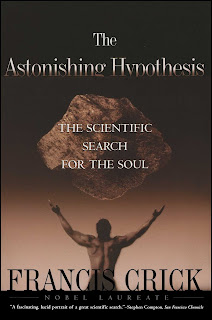
The Astonishing Hypothesis: The Scientific Search for the Soul – Francis Crick (1994)


            The title of his book is a bit misleading.  Francis Crick, one of the group of scientists responsible for our current knowledge about DNA, its structure, and how it works in living plants and animals, is not discussing what theology and religion call a “soul.”  What he seeks is the means and methods by which humans can empirically study consciousness/awareness itself.

            Consciousness is a very tricky subject for everyone involved.  Research scientists rarely explore consciousness itself, instead seeking to understand the physical workings of the brain.  Philosophers explore consciousness and awareness but do not use the knowledge derived from the decades of work done on physical brain structure, and the function of the many neurons in our brain.  This creates a vast gap of knowledge.  We know mostly how individual neurons work, and roughly how many areas of the brain correspond to different functions and cognitive abilities.  What we do not know includes what parts of the brain control or experience consciousness, exactly how we create and store memories, both short term and long term, and how we manage to process the myriad sensory inputs we constantly receive.  This book is Francis Crick’s attempt to survey the current state of things (as of 1994) while shining a light on many areas of research that could lead to fruitful answers, focusing mainly on visual Neuroscience.

            The “Amazing Hypothesis” in question is the proposition that what we call consciousness, and some call a “soul,” is a product of the way the brain’s neurons function, specifically the complex human brain, and that through empirical experimental methods we should be able to discover and understand the actual structure that brings about consciousness.  As the brain and all of human experience constitutes an exceedingly complex and varied system, it is best to try to study one specific aspect, hoping it sheds some light on the bigger picture.  Mr. Crick decides, based on the then-current state of scholarship, to focus on the specific ways we see, and how our brains process what we see.

            While many of the sciences have spent the past 100 years discovering deep truths about the world around us, this has not happened in the study of the human brain.  There are several reasons for this.  Firstly, it is considered unethical to conduct brain experiments on humans unless they have already suffered some sort of trauma/damage to their brain and willfully allow a scientist to experiment.  Secondly, the study of consciousness has been relegated to philosophers and theologians, most of whom know very little about the actual structure and function of the brain and its constituent parts.  This means that their explorations are more guesswork than deduction.  Thirdly, while we can study the brains of cats, rats, monkeys, or other lab animals, this does not necessarily translate to the human brain.  While a human being can be certain that they themselves are conscious, and be fairly certain that other humans around us are conscious, it is a much bigger jump to assume that other primates and animals share the same consciousness that we do.  A monkey is taught/trained to do certain tasks while their brain is monitored, but they cannot provide actual feedback like a human could.  Many scientists end up focusing solely on structure and the electrochemical reactions in the brain and not on what they mean for the study of consciousness.

            Francis Crick decides that in order to pick a specific area to research that is likely to provide the best answers to the consciousness question it is best to focus on sight.  How do we see?  How do our eyes, nerves, and brain work together to understand what is being seen?  This seems like a promising point of departure in the search for our consciousness.  Crick spends the first part of this book detailing the then-current state of scientific knowledge, exploring everything from studies on the eye’s retina, to the structure of neurons, to the many ways they communicate both within and without themselves.  One item that surprised me was the knowledge that many of the neurons that help the retina function act as a processing center, before the information reaches the brain itself.  In fact, the nerves that feed what your eyes see to the brain are part of the brain itself, not just a connection. It is as if neurons from the developing embryo brain reach out to connect to the developing eyes. Quite cool stuff.  What is also evident in the background info Mr. Crick provides is the vast amount we do not know.  We have very rough guesses as to what regions of the brain handle specific tasks.  We still do not know how exactly the brain regulates the massive sensory input it receives every moment of every day.  We have no idea how or where memories are stored.  This vast ignorance is actually a great thing for neuroscientists, as it helps guide them to new experiments and areas of research.

            The latter part of the book details many possible areas and studies that could be done to try and find the answers Mr. Crick looks for. Over a century ago it was common for educated people to believe that a Life Force flowed through living beings, separating them from the inanimate objects around them.  No other way could be imagined for the growth of the young, the way offspring look like their parents, etc.  Once we understood the cardiovascular system, the pulmonary system, and finally the structure, function, and purpose of DNA, the idea of a Life Force dissipated and was dropped by humanity as a whole.  Francis Crick thinks that is where we are at today in regards to the human “soul.”  Many blindly accept that it exists, especially in the forms that theologians and philosophers feel it does, but this could change were we to understand the workings of our brain.  We may find that consciousness is a direct result of life itself.  We may find that what we call consciousness is a trait shared by any and every creature with a neuronal brain, or we may find that only the human brain possesses the required structure to function as an individual consciousness.  The field is wide open and I cannot wait to read more.  It is nearly 30 years later and we still do not have answers to most of Francis Crick’s questions. 


2.8.18

Is Mind inherent in all of Existence? How can it not be?


Panpsychism in the West – David Skrbina (2017 Revised Edition)

      It has been almost 4 years since I first began posting reviews of the books I read on this blog, RXTT’s Book Journey.  One of the most gratifying and unexpected outcomes of this project has been the ability to correspond with some of the authors of the books I read.  It always thrills me when they reply to my communications.  One of the many who I have had a chance to correspond with has been mathematician, educator, and cyberpunk O.G. Rudy Rucker.  I always make sure to ask these authors if they can suggest any reading recommendations, and Rudy Rucker told me that this book, Panpsychism in the West, was one to check out, as he had recently enjoyed it very much.  The name David Skrbina was familiar to me based on various references to him and his writing in other books I read.  It was awesome to have such a great recommendation, and greatly appreciated.

      This book details the development, discussion, history, and possibilities of the philosophical idea called Panpsychism.  This idea suggests that the entity we call Mind is inherent in all of existence, and that this should affect everything about how we see ourselves, life, and the whole of existence.  Many of the Greek philosophers, who first pondered the reality of the world around us, our bodies, and our minds, came to the conclusion that Mind, consciousness itself, was an underlying part of everything that exists.  One of the arguments for this was that human beings feel they have a mind separate from the nuts-and-bolts physicality of their brain.  However, Humans are created from the very same stuff as everything else, and because of this our “Minds” cannot be a special occurrence.  Some form of “Mind” must exist in any and all life, and possibly into inanimate matter we deem to be not alive, perhaps even to the basic building blocks of matter.  They saw the human body as an aggregate of its many parts, and because of this, the parts themselves must have had some sort of “Mind”, just as the bigger systems around us, the atmosphere, the water cycle, the Earth itself, must also have a “Mind” constituent. 

      Later Greek philosophers would turn from this idea and head towards a mechanistic and non-spiritual perception of the Universe around us.  These ideas led to the Materialist universe in which modern humans exist.  We are told that the Mind is either purely a god-given trait solely found in Humans, or that the Mind sprang up only in Humans because we were the only ones to have a  complex enough nervous structure and brain to achieve this.  These human-centered objections to panpsychism have been put forth by philosophers and scientists throughout human history.  They only serve to point out the inherent bias among thinkers who ascribe all experience value based on their personal state, that of being a human on Earth.  They demean the experiences of animals, plants, and even rocks as purely mechanistic, even as they aggrandize the human experience.  This seems a contradiction to me. 

      Once the mechanistic worldview of Isaac Newton and classical physics began to influence the world, philosophers sought to discredit the idea of panpsychism by exclaiming that it was unscientific, in that there was no empirical way to test whether a rock or a tree has a Mind.  The blind-spot in their arguments is that, as of today, there is no way to empirically prove that a human has a Mind!  If it cannot be proven to exist in us, how can they be so sure it does not exist in the world around us?  Too many people run with this argument and fail to understand that panpsychism is not a scientific idea, but a philosophical one.  Empirical science can analyze a brain, the neurons and axions that make up the physical brain, and the various blood vessels that nourish and clean the brain, but they cannot in any way analyze the Mind.  Psychologists have tried, with varying degrees of failure, to analyze Mind as separate from the physical brain.  Psychiatrists try to utilize medicines and chemicals to force the physical brain into adjusting the process of the non-physical Mind.  It is a very confusing state of affairs.

      David Skrbina has done a great job of compiling not only the various supporting ideas and players throughout human western culture to discuss panpsychism, but also of the many philosophers and scientists who sought to deny panpsychism.  He explains how they came to their negations, and the ways in which they misunderstood the basic concept of panpsychism.  Many philosophers would push these ideas only to negate them later on in life.  Yet others, people who decried the possibility of panpsychism, came around in their later years and admitted that there is no way to discount the idea.  How their ideas went on to influence those that followed, and how the possibilities inherent in panpsychism would change the entire world-view of the whole of humanity is a focus of the later part of this book.

Philosophy as a field of study for me is very frustrating.  I find it hard to read the conclusions and assertions of philosophers whose base assumptions are inherently opposed to how I see the world around me.  It is very hard to argue with a dead philosopher!  I love to know the history of human thought and the development of our ideas on ourselves, but so much of it is purely fantasy, conceptualized reactions to embedded presumptions.  I feel that, as a basis of thoughtful exploration, it is much more valuable and realistic to assume that, just as we are part of the Universe, and have a level of awareness we call Mind, that every other constituent part of the Universe, both smaller and bigger than the cellular aggregate we call a human being also shares in this noetic quality.  It is impossible to draw a line of demarcation where Mind exists and then where it does not.  For example, we can say humans have Minds.  Many of us feel that our pet dogs and cats have their own Minds and personalities, independent of their physical being.  Is that the end?  Why wouldn’t smaller animals, such as mice or beetles or even amoebas, also share in this feature of existence we label a Mind?  If a one-celled organism can have a Mind, what about the single-cells that make up all living beings’ body structures?  If a cell can have a sliver of consciousness then what about the component parts of that cell?  Digging lower, what about the individual molecules and atoms?  What about the constituents of atoms?  No one can provide a definitive answer to where the line should be drawn.  Going bigger than humans, are larger aggregates like cities, mountains, oceans, planets, galaxies all possessed of a higher level of mind that we humans just cannot comprehend?  This book has given me quite a lot to think about.  It is highly recommended.

(The 2017 Revised edition of this book is available for purchase here: PANPSYCHISM IN THE WEST  )