Showing posts with label Books. Show all posts

22.8.24

To My Readers


For the past decade I have published my thoughts on the many weird books I read.  In that time, RXTT’s Book Journey has grown in ways I never imagined, reaching readers worldwide.  The blog arose because of my love of the old, weird, out of print, and reference books, and my wife’s desire that I share my thoughts on them with the world at large, as I always do with her.  She is my inspiration.

If I believe in anything, it is the power of the wisdom, stories, and information contained within humanity’s writings.  The ancients assured us that language and written words were powerful tools.  “In the beginning was the word,” and all.  Our thoughts may or may not shape the world around us.  The mystics still debate.  However, our spoken and written words most definitely DO shape the world around us.  I am not the man I am, and this world we share is not the world it is, without the words handed down through the thickness of time. 

An example, nearly one hundred years ago, a man named Vonnegut witnessed the fickle whim of man’s inhumanity to man.  Decades later, after many stories and books, he wrote a novel called Slaughterhouse Five, or The Children’s Crusade.  In it, using the constructs and themes of science fiction (time travel, aliens, dimensional travel, lunatic fringe, etc.), Vonnegut vomited out his vitriol, pure and choleric, upon the vast, unchanging, and overwhelming stupidity of man, the stupidity that would allow for war, slaughter, pain, and terror to be the tools used to bring “peace.”  He told the rest of us what many tried to, but none had done in words which both a bright thirteen-year-old, and a deeply wise octogenarian would understand.  It is the saddest and funniest book I have ever read.  It changed who I am deeply, altering everything I have ever done, and every interaction I have ever had.  If that is not power, then nothing is.  That is just one book.  One among thousands published in my country that year alone.  It is said that most of the words written by man have been lost.  The works humanity is aware of existing are nearly infinite.  Thinking about the vast oceans of lost works is like mental torture to a book lover like me.

It is a mindboggling thought as I desire to know as much as possible, to understand as much as possible, at least about what interests me.  Because of this desire, I also flatly understand the impossibility of my dream.  I stare bluntly ahead, facing my own wall of ignorance, the mountain of books and wisdom and teachings lost to time, but specifically to me.  I think this is something all book lovers face sooner or later.

It is because I love books that I wanted to create RXTT’s Book Journey.  Each new book is a new world to explore, or a new idea to ponder, and I have travelled deep and wide, reading what interested me, when it interested me.   I appreciate a well-written, insightful review, whether it be of a film, book, or kitchen appliance.  It is a pure communication of ideas.  The feedback I receive from the authors themselves, sometimes concerning a decades-old book of theirs, is precious to me.  Corresponding with, and hearing sincere appreciation, from giants such as Freeman Dyson and Alan Moore was a never-imagined dream come true.  Meeting and reading brand-new works from young writers is an equal thrill, and I have been very fortunate in that regard as well. 

Writing a novel is another story.

While not many of the books I read are fiction, I love the power of a well-crafted story to illuminate, entertain, and enlighten its reader.  Most life-long readers dream of writing their own novel, and many try.  I joined them.  I wrote daily.  My story grew.  The world I created filled up, the story flowed like a glacial stream, slow but steadily building, and I managed to complete it.  IN CRED is my first novel.  I wrote it mindfully, wanting to present a self-contained world, a story entertaining and intelligible, to any clever reader willing to explore the mindways.  The tens of thousands of readers I have worldwide showed me that there are many like me, many who want deep dives into old texts, who are curious to know what the source materials are like.  Readers whose favorite reading experience is not the self-satisfaction of a driving plot, or the florid oscillation of word and language, but the quintessential feeling of having one’s mind BLOWN AWAY by a new idea.  I want my readers to experience that as often as possible, and I wrote IN CRED with you in mind.

Once finished, I had to share it with someone.  The magic and power of words truly spark up when they are shared.  I handed IN CRED to my wife.  I shared it with some close friends.  I reached out to a couple of authors I call friends and asked them for their opinion.  Their feedback and appreciation mean everything to me.  It took some internal literary courage, but I worked diligently to make IN CRED available to readers. 

It is available on Amazon, in Kindle eBook, glossy paperback, or hard cover versions. (I used my B.F.A. in Studio Art and drew the cover artwork also.)

IN CRED’s dedication page may speak of my wife and parents, but IN CRED would not exist without the readers of RXTT’s Book Journey.  I so greatly appreciate that you are out there, wherever you may be in this beautiful world of ours.  I hope my reviews have enlightened and informed you in the same way that the books I love have enlightened and informed me.

If you love science fiction that explores intimate segments of what it means to be human, you will enjoy IN CRED.  If you seek speculative fiction with big ideas told in intimate ways, you will love IN CRED.  If you enjoy original characters and settings, and a clever story whose progress is constantly surprising, you will love IN CRED.  If you appreciate literature that is honestly edifying without being sentimentally trite, IN CRED is for you.  If you enjoy stories where daily experiences go batshit crazy, and regular people are forced to deal with it, you will enjoy IN CRED.

This is just the beginning.  The spigot has been opened.  Further stories are in the works, and I am very excited about it.  If RXTT’s Book Journey was an initial stab at sharing my thoughts with the world, IN CRED is a mighty cannonade.  I would love for you, my fellow readers, to dive into IN CRED and let me know your thoughts!  Stories are magic, and I have just begun the show.


Sincerely Yours,


RXTT


25.10.23

Robert Crumb illustrates the Book of Genesis, and It Rules


The Book of Genesis Illustrated – R. Crumb (2010)


            I was gifted this amazing book by my brother.  As a life-long fan of Robert Crumb and the big-butt, thick-legged femeninas he obsessively drew and lusted over, I wondered how his obsessive drawing style would lend itself to the stories contained within the Bible’s Book of Genesis.  As with any genius artist, the results are more enjoyable than the actual source material.

            The Book of Genesis is, like the rest of the Bible, a composite.  The stories told within it are drawn from so many ancient sources that the words of Genesis constantly contradict or negate each other.  For example, Genesis tells two different stories about the origin of the world.  In one, god created everything all at once, and seeing it good, created man to rule it all.  In the other version, told right after, god creates the universe bit by bit, day by day, until finally creating man on the 6th day, and resting on the 7th.  This contradiction is never explained by the devout, who parrot the Bible as a holy book directly transcribed from the mind of god, infallible in all ways.  These people are idiots, seeking to turn everyone else into the mindless drones they themselves have become. (To read a review of Isaac Asimov’s Guide to the Bible, where he discusses the many source materials for the sections of the Bible, click here: https://rxttbooks.blogspot.com/2014/09/isaac-asimov-tackles-biggest-book-there.html )

            Robert Crumb is a very interesting person to undertake this difficult task.  He was born to a Catholic household, but never sought religion or spirituality after his youth.  In fact, as a devout teenager, his father admitted that the Catholicism he raised the Crumb family under was a lie, and that he was an atheist all along, just pretending at religion.  Robert Crumb’s involvement in the underground comic books of the 1960’s helped make him a seminal figure in the alternative media world.  Nothing in his work of that period showed a predilection toward Bible subjects.

            One of Crumb’s collaborations, the many issues of American Splendor he drew for Harvey Pekar, pointed the way to how his art could serve the needs of a narrative structure.  Harvey Pekar’s work consisted of vignettes, detached scenes of his everyday life.  Crumb drew these scenes in his inimitable crosshatch, but without any of the sensational or outrageous imagery commonly associated with ZAP or WEIRDO comics.  It is this method he employs for the book of Genesis.

            What a beautiful book it is.  Each page, each panel, is carefully structured and drawn, allowing for maximum storytelling.  Crumb draws everything, even the preternaturally dull sections of Genesis listing endless “begets.”  His art does not editorialize.  It does not seek to magnify or diminish the words of Genesis, merely to portray them in a straight-forward manner.  As a life-long fan of the Illustrated Classics comic book series, I felt right at home ingesting the first chapter of the Bible in comic book format.  Those Illustrated Classics were my first exposure to Moby Dick, Robinson Crusoe, Robin Hood, and many other works of literature.  I can imagine this great book serving the same purpose for anyone interested in actually reading the Bible, instead of analyzing it for divine proclamations.  I also see it as a great stepping stone for other comic book artists to explore the canon of classic literature.  Robert Crumb has always kept himself at the leading edge of sequential storytelling art.  We are better off for it.


(The Book of Genesis Illustrated can be purchased here: https://wwnorton.com/books/The-Book-of-Genesis-Illustrated-by-R-Crumb/ )


8.2.23

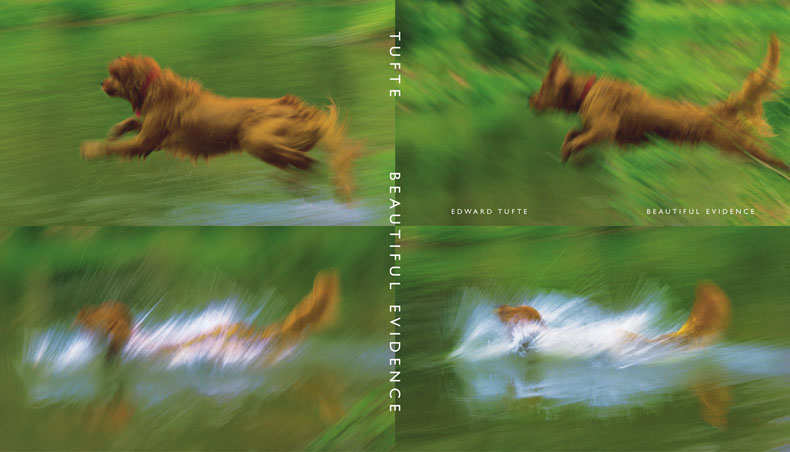
Edward Tufte Shows Us How to Properly Share Data That Combines Text, Numbers, and Images


Beautiful Evidence – Edward Tufte (2006)


            Sometimes the book lords look down upon us lowly humans and grace us with tomes we would otherwise not read or know about.  Such was the day I found this amazing work by professor, author, and sculptor, Edward Tufte.  As one of my co-workers cleaned out her office, she stacked a bunch of books aside for anyone who wanted them.  I grabbed three that caught my eye, and immediately began devouring Edward Tufte’s masterpiece.

            The introduction to this work explains Tufte’s focus, the intersection of science and art, specifically as it relates to the dissemination or presentation of raw data.  One of the thoughts in his Introduction really hit home for me, “Making an evidence presentation is a moral act as well as an intellectual activity.”  This goes for the consumers of these presentations as well.  One must be ready, when faced with a presentation of evidence, to think and judge not only what data they discuss but also how they present it.  This analytical thinking is crucial to the proper dissemination of knowledge in our data-packed world.

            Tufte begins his exploration of this subject by focusing on what he calls “Mapped Pictures: Images as Evidence and Explanation.”  He, much like I do, deplores the out-of-context images used by periodicals when writing about scientific subjects. An example of a well-mapped image is the type used in visual catalogues of flora and fauna, where, for example, the fish in question is portrayed in both profile and overhead views, which provides much more data than a single image.  Those images may also contain data about the subject, such as the length of the fish, the coloring of the fish, the species’ Latin name, etc.  Many of these animal catalogues fail to provide much data, apart from the image of the animal itself.  This is a disservice, both to the scientists that catalogued the animals, and to the reader wishing to encounter useful and correct information about them.

            Tufte provides beautiful examples of many types of mapped picture, from images detailing which stars make up the constellations in the sky, to diagrams showing the horrendous conditions that Africans were placed into by their captors who sought to pack as many onto these ships as possible.  Such an image shows not only the extent of the horror, but specific details of the horror, allowing the reader to grasp a far bigger idea than just the image itself.

            The author analyzes other methods of information exchange.  From sparklines (a graphic showing a change in value over time, such as a line graph representing the temperature in a given city over a month) to word and arrow diagrams (such as a family tree, or an evolutionary line), each is discussed at length.  Mr. Tufte seeks to show the best possible ways to convey information, keeping in mind each method’s weaknesses and strengths.

            In the chapter on the confluence of words, numbers, and images, Tufte’s first example is from the genius of Leonardo da Vinci.  In his countless notebooks, where he wrote and drew about his constant explorations, vivid drawings live right next to explanatory text and data in number form.   The ability to combine all three into a work so profound shows the reasoning and ability of da Vinci’s deep skill.  As Tufte proclaims, it is a shame that more scientists have not taken up the model provided by Leonardo.

            Another aspect of publishing that upsets Tufte, for it derails the hard work of the scientists, is what happens when publishers create new editions of classic books.  For some reason, the editors feel they need to re-arrange the layouts of the books, shifting all the text into one section, and placing the images in another.  When the purpose of the book is to educate, using words and images concurrently, such as in Galileo’s “Siderius Nuncius” (The Starry Messenger), too many publishers fail to see the importance of both text and images living side by side.  Moving images to an appendix reduces the capability of the reader to grasp what the author intends.  The worst example of this is in the editions of Isaac Newton’s “Opticks.”  Tufte shows how, from the initial pressing in London, the pertinent images were placed in a separate section from the text they belong to.  It was not until the first German edition (1898) that the images and text were fully integrated.  In 1952, the first proper printing in English occurred.  Sadly soon after four more badly edited editions would see the light of day.  As Tufte states, it is a shame that “…it took 258 years to combine word and image in the original English.”

            The latter half of this book explores the fundamental principles of analytical design, and provides some amazing examples of quality work.  The best part of the second half of the book is where Edward Tufte patiently explains the many ways that data is corrupted in evidence presentations, with the most vitriol aimed at the ubiquitous and hated Power Point software.  The damage that PP has done to professional information exchange is hard to calculate, but Mr. Tufte does a great job of explaining it.  The saddest fact I read was how, when the space shuttle Columbia accident occurred, an independent body analyzed NASA’s information exchanges, focusing on how warnings about the shuttle were ignored or avoided altogether.  The analysis showed that nearly 90% of all data shared at NASA was in the form of PP slides.  HORRENDOUS.  Tufte explains how these slides, containing minimal information, and allowing for minimal understanding, corrupt the very processes intended to inform and educate, leading to tragic errors and human suffering.

            As it should be, this book is a beautiful production.  Edward Tufte uses all of his skills and knowledge to construct a perfect blending of image, numbers, and text.  He sets a great example for anyone writing in the sciences, and anyone seeking to share information properly.  For a visually oriented person book lover like myself, this was an amazing discovery.  The book angels were looking out.  I highly recommend this book and hope it influences many to think deeper about how to portray their data, and how to engage the mind of the reader.


(This book can be purchased from the Author here: https://www.edwardtufte.com/tufte/books_be )