Showing posts with label Rock. Show all posts

21.3.25

An Overheard Conversation Leads to a Fabulous Book Detailing Postpunk Music and Times


Rip It Up and Start Again: Postpunk 1978-1984 – Simon Reynolds (2005)


             Yes!  Once again, a recommendation from a Library patron turns out to be amazing.  Overhearing a discussion between our Librarian and the patron in question, the words “Rip It Up and Start Again” rang in my ears.  I interrupted them to ask if the book had any relation to the Orange Juice song, which, by fortuitous occurrence, I had just listened to on my daily post-lunch walk around campus.  The patron stated that, yes, the books title was taken from the Orange Juice track, and that the book was a history of postpunk music, well-worth reading.  After a quick request through the Inter-Library Loan program, the book was in my hands days later.

            As a devoted music fan, specifically of the more subversive and transgressive music from the 80’s and 90’s, I had read plenty on the Punk revolution of 1977, and of all the progenitors to that scene, artists such as the Velvet Underground, The Stooges, The Ramones, etc.  While people to this day play and perform “punk” rock music of all types, the initial incandescence of Punk was extremely short-lived.  Between 1976 and 1978, the Punk scene rose and died, mainly in the UK.  The ideals of a return to simplicity, to the feel and vibes of the initial rock legends everyone idolized, were a reaction to the inherently bloated and self-important nature of what was seen as rock music in the 70’s.  The rise of anemic, glossy, adult-oriented “rock” coincided with an explosion in the complex, obtuse, and difficult music or “progressive rock” and the inflation of the rock superstar mentality.  This led to the seemingly-regressive ideals of punk rock.  It was no longer important to be a trained, expert musician, or to pose as an “artist” creating important music. 

            The initial death of Punk coincided with its appropriation by the record companies seeking new money-making material.  Most of the early punk bands self-released their music, which sold well enough, but once the fad of “punk” hit the suburbs, the record companies sought to cash in.  In the aftermath of all this, a new crop of bands appeared, seeking to move forward, not backwards, and to seek new ways of making music more resonant with their modern world than the throwback Punk music of the previous few years.  To them, the retro-worshipping stance of the early punks was invalid, for in seeking to make the sounds of the future they simply reiterated the initial rock sounds of the past.

            The 7-year period covered in this book was one of infinite creativity, cynicism, and wild musical exploration.  The adoption of synthesizers, the refutation of the standard bass, drums, and guitar set-up, and the plunge into atonality all contributed to create wholly new music.  Although I was too young to experience most of it, many of my favorite acts were heavily influenced by the postpunk bands.  Groups such as Sonic Youth, The Butthole Surfers, and Big Black were my bread and butter.  Reading about the bands and times that influenced them helped me understand my faves more.

            Books such as this one provide first-hand context for the bands and music of this time.  They also help shine a light on bands that otherwise would stay vague memories in fans minds.  I learned a lot about bands such as The Fall, KLF, Scritti Politti, The Mekons, and others whose records I had seen, or whose music I had heard praised by the bands I like, but have never explored sonically.  I also learned many new things about bands I have loved for years, such as Public Image Limited, Suicide, and the aforementioned Orange Juice. 

Much like the experience of reading Thurston Moore’s “Sonic Life,” this book transported me to a world I have only seen referred to or mentioned tangentially.  The bands and music scenes detailed within ‘Rip It Up and Start Again” attempted something original, to try and create new music without the oversight and control offered by the record companies, music attempting something new and modern.  It was these bands, not the punk bands, that paved the way for the DIY and independent music scenes of the 1980’s in the USA and UK, allowing home-grown networks of promoters, clubs, record labels, and independent bands to travel the country and answer to no one but themselves.  Too often, artists who do not make it into the mainstream culture are forgotten, and their contributions are ignored, or bypassed in favor of the cleaner, generic acts that normally populate the charts.  Simon Reynolds has done all music fans a great service by writing this book.  Highly Recommended.

(This book can be purchased here: https://www.penguinrandomhouse.com/books/291130/rip-it-up-and-start-again-by-simon-reynolds/ )

13.5.19

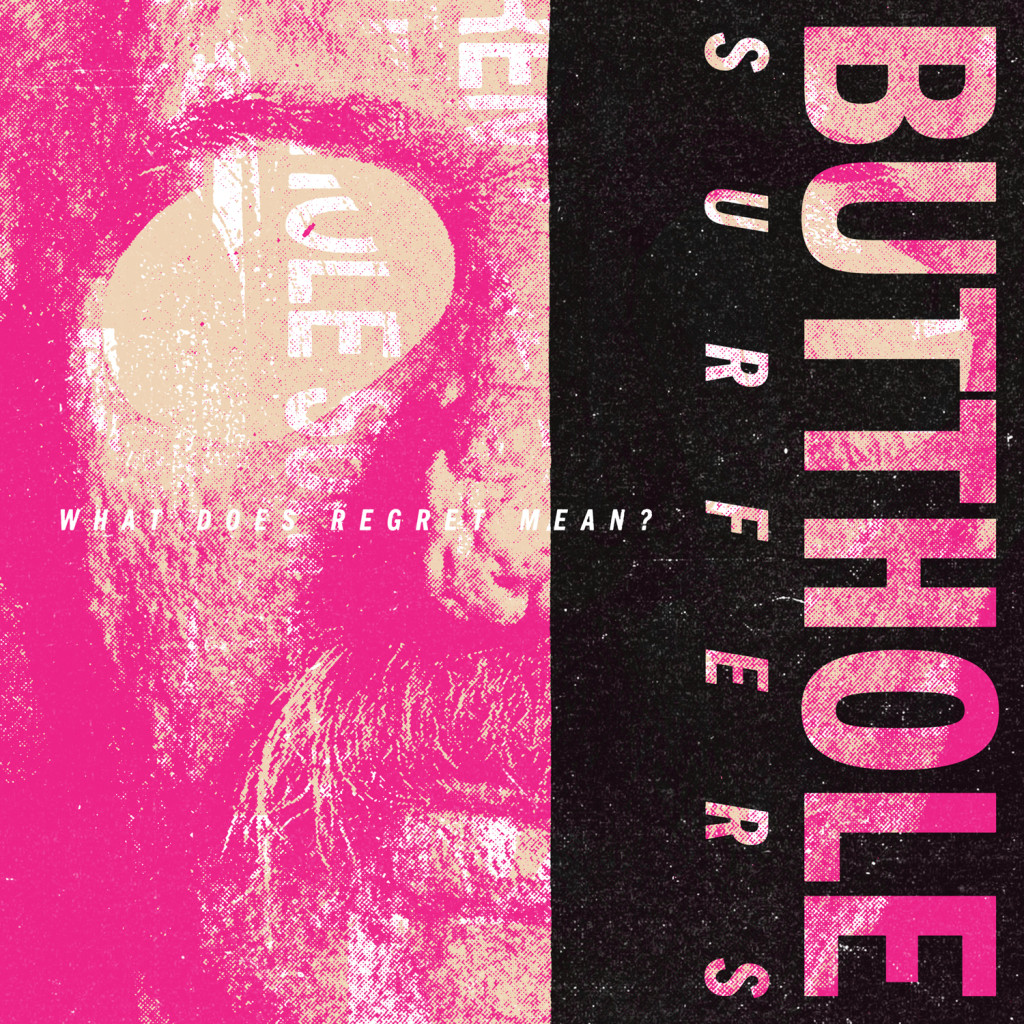
The Butthole Surfers Regret Not Regretting Anything


Butthole Surfers: What Does Regret Mean? – Aaron Tanner (2019)

            As a teenager, bored with hard rock and heavy metal for the most part, I sought out music that scared and excited and confused me because I was just so sick of the crap that MTV, radio, and the “norms” thought was good music.  I wanted the transgressive, the avant-garde, music that is so fresh and new and different that most people would hate it for years, until their feeble ears and brains could slowly catch up.  The first bands that sent me down this awesome spiral of skronk and freak-out were Jane’s Addiction and Sonic Youth.  Both were loud, rocking, and aggressive in completely different ways, and both sounded nothing like the formulaic heavy metal and thrash that had been rattling in my ears.  One band that was always mentioned alongside these two faves of mine was the Butthole Surfers.  

           My friends and I would drive into town in one of our parent’s cars on a Saturday and hit up the cool record stores.  At Sound Exchange, I would peruse the used cassette section, and every time I picked up one of the Butthole Surfers' albums, I would get a queasy feeling based purely on the visual aesthetic of their releases.  It was just SO WEIRD.  They did not list the band member’s names or song titles all that often, but what I did see is still burned into my mind.  I was too young and naïve to understand that an artist’s image is mostly a fabrication.  I was also too young and naïve to understand that the Butthole Surfer’s image was not in the least a fabrication, and that they were fully the weirdest single group of musicians I would ever have the fortune to listen to and love.

            Sometime in my first year of study at the University of Houston, my friend Barnaby Struve kept playing Butthole Surfers vinyl for me.  At one point he made me a 120 minute compilation cassette (remember when you could record 60 minutes of music on each side of a Memorex cassette?) of what he described as “the choice cuts.”  It was a revelation.  Even without any of the art, liner notes, or bizarre imagery, the music itself blew my teeny little mind.  I grew to LOVE these songs, to understand and relate to the insanity within, to see the undeniable beauty contained within, and to appreciate the balls it took for this band to stay true to their demented idea of themselves.  I played that cassette so many times.  I dubbed it for at least 5 different friends.  At parties, I would commandeer the stereo and play this Butthole Surfers compilation repeatedly (some people were not too happy about this).  The music was like instant intoxication, if that intoxication actually exposed the ugliest sides of ourselves.

            That was in 1991-1994.  The Butthole Surfers had been taking cares biz-nass since 1981.  Never during that time period would anyone even remotely aware of the Butthole Surfers consider that in 2019 a lavish, expensive, and downright beautiful coffee table art book would be released based mostly on the imagery the Butthole Surfers used in the promotional material, records, and merchandise.  Before the internet, the main way you found out about bands was from word-of-mouth, or lucking into seeing them as they opened up for someone you liked, or seeing a cool t-shirt on someone and striking up a conversation.  The Butthole Surfers were a band whose fandom grew in this manner, because everyone that witnessed a live show could not stop talking about it.  There was no other band like them.  There will never be another band like them.

            This book is like a deep time-slip dive into our collective Butthole Surfer past.  I cannot emphasize how often my shit-eating grin would appear on my face as I read this book.  Whether this was because of the many amazing images and fliers and promo materials, all presented like a DIY ‘zine, or because the commentary and remembrances sprinkled throughout brought me back to those times.  I was too young to see the Buttholes perform their insanity at small clubs in Texas, but I did get to see them perform many times, including at Lollapalooza where singer Gibby Haynes used a shotgun loaded with blanks to shoot at the crowd.  That shit was scary.  This book is scary.  The Butthole Surfers are scary.  They have to be.  I would not have it any other way.

            Aaron Tanner’s goal with this book was not to write a history, even though it is constructed sequentially.  He sought to share with the world just how individual and amazing the visual component of the Butthole Surfers’ myth was, from promo materials, to zines, to album notes, and personal photographs.  He has created something that I will treasure all the days of my life.  To top it all off, a flexi-disc is included with the book, containing a track that was to be used as a B-Side during the Independent Worm Saloon era.  Such cool stuff.  For a die-hard fanatic like myself, it is pure joy.

(BTW, I have played my wife 5 different Butthole Surfers songs over the past 8 or so years.  Each and every time she hears a new one, she tells me that it is "the single worst song she has ever heard."  This makes me laugh with glee and appreciation.)

(The Regular edition is sold out.  The Deluxe Edition is still available here: Melodic Virtue )

14.11.18

Sonic Youth is Dead. Long Live Sonic Youth.


Spirit Desire – Jennifer Benningfield (2018)

            I am a Sonic Youth Lifer.  The skronkalicious foursome has been my favorite musical group for the past 30+ years.  As a part of my fandom, I have been a member of the Sonic Youth Gossip Forum for nearly the entire existence of the interwebs.  In that nebulous cul-de-sac I met and have befriended many a fellow Sonic Youth Lifer.  I have seen them grow up, rock out, and move on with their lives.  I have lost Sonic friends who passed too early (RIP Adam “atsonicpark” Cooley - http://directoradamcooley.angelfire.com/ ).  I was also exposed to some of the most creative, interesting, and downright bizarre people, all of them Sonic Youth nuts to one extent or the other.  One of these bad-asses is Jennifer Benningfield, or as she is known on the SY Gossip Forum, jennthebenn.  In 2009 she published her first book, No Setlist: Pieces of a Sonic Life, detailing her near-obsessive devotion to traveling for Sonic Youth concerts.  My review of that book is here: http://rxttbooks.blogspot.com/2017/06/rxtt-flashback-review-story-of-sonic.html .

            It is now 2018, Sonic Youth have broken up, and the individual members have moved on to new musical projects, as varied as one can imagine.  Jennifer Benningfield has released the follow-up to No Setlist.  The development of her writing voice and style are evident throughout, as the book is tighter, funnier, and in many ways more resonant than her debut.  Like before, the book is divided into sections detailing individual Sonic Youth concerts she attended, describes the moment she and her partner in crime, Patrick “pantophobia” Suddath learned of the imminent breakup of our favorite band, and finishes with her treks to various post-Sonic Youth concerts.

            If it was inspiring to me to read Ms. Benningfield’s initial love letter to the Youth, it was even more amazing to read this new book, appreciating the growth and maturity of writing that has allowed Jennifer Benningfield to submit her short stories to various hard-copy and online publications.  While I do not personally know her, having had little interaction with her besides the Sonic Youth Gossip Forum (and the Instigator Fantasy Football league which I run every year.  Jenn’s team is Snoopy’s Smash Squad, and anyone who knows her knows she has a near-fetishistic fascination with Charles Schultz and the Peanuts gang), I am so proud of this digital friend for grinding away, for continuing to write and submit, even though the rejections and tough times can seem never ending.  The band is very lucky to have someone such as her as a fan.

            One of the little oddities that I found endearing in this book, is the way that, as a super-fan, Ms. Benningfield describes the journeys taken to the shows, the people she meets and stays with, the long-distance friends she connected with, the fearful walks through unfamiliar neighborhoods in search of a pre-show meal, and everything that goes into attending rock shows.  I myself have attended countless hundreds of not thousands of rock shows, and these little details are the ones that actually make the occasions memorable, apart from the musical performances themselves.  There is a huge difference between going to a big, national touring show at a giant arena, and going to a small touring act performing at who-the-fuck-knows-where.  It is more personal, more intimate, and if you are one of the early arrivals, like Ms. Benningfield likes to be, you can be in the FRONT ROW!  (I never ever stand in the front row.  I am 6’2” tall, and no one likes my ass blocking their view.)

            Sonic Youth is no more.  The Sonic Youth Gossip Forum is creaky and increasingly less populated.  The Sonic Lifers have had to move on.  Our favorite band, the band that never even sold 250,000 copies of any release, that taught so many of us what noise as Art was, and the possibilities inherent in that, will never come together in skronk again.  All we have are our memories, and thanks to the mind and work of SY Lifers such as Jennifer Benningfield, we can all share in our collective Sonic Joy.  SONIC LIFE!

(This book can be downloaded and read here: https://trapperjennmd.blogspot.com/2018/07/spirit-desire.html)

21.6.17

*RXTT Flashback Review* The Story of a Sonic Youth Fanatic and her Adventures in Skronk


NO SETLIST: Pieces of a Sonic Life - Jenn Benningfield (2009)

(Today on RXTT's Intellectual Journey, we go back to a book review from several years ago, that I published on a different blog, -FUPPETS- , which is now-defunct.  The review has been edited slightly. - RXTT)

Long-time Sonic Youth fanatic and all around bad-ass, Jenn Benningfield, has documented her obsession with live Sonic Youth concerts, as well as the life that develops around such an obsession, in her book NO SET LIST: Pieces Of A Sonic Life.  I have absorbed the book, and what a book it is. While the omnipresent Sonic Youth are integral to the book, it is Sonic Youth's peripheral universe that is the real star here. 

The lines of uber-fans showing up hours early, the crowds of people that frequent the shows, the travel required to attend 40+ shows and the inevitable highs and lows of that travel, the camaraderie between people who are total strangers except for the fact that they love skronk rock, and most of all, the joy of the fleeting moments shared with one's musical idols, these are the main pillars of NO SET LIST. 

The bits that truly hook the reader though, are the relationships that Jenn builds with her fellow fanatics, whether at shows or through meeting those people she has corresponded with on Sonic Youth's infamous Fan Gossip Forum, including one who would become her partner-in-crime for much of NO SET LIST's duration. Her travels begin close to home but soon take her throughout the Midwest, California, Oregon, and as far as Britain in search of that sonic eargasm that only Sonic Youth can provide. Planes, trains, and automobiles are all endured, travails are overcome, and health issues are faced, all with humor and biting wit, and with the help of Snoopy's all-consuming love. What could easily become rote, (the endless bus/train stations, the countless opening acts, the obsession with Sonic Youth), never does and this is a testament to the quality of the writing within, not to mention the quality of the mind making the observations which we are absorbing. 

Sonic Youth is not an "easy" band to like. They go out of their way to test and expand their audience's ears. They are a group that seeks to make art, and that seek to push the envelope as to what can constitute great musical art. Jenn captures all of this, as well as the blinding white skronk joy that Sonic Youth give to those that are patient and keep their ears open. NO SET LIST opens this world and exposes it to the light. What we find inside is comforting, exhausting, exhilarating, and downright beautiful. I wish Jenn was put on retainer by Sonic Youth so as to document their every appearance! That way, I would have a mainline to the world's greatest band, and there is nothing better. I would like to thank Jenn Benningfield for writing NO SET LIST, and for having the balls to put herself and her writing out into the world.

(This book is currently out of print)

1.2.17

Hail! Hail! Rock n' Roll! (and Chuck Berry too!!)


Chuck Berry: The Autobiography – Chuck Berry (1987)

            I am not a fan of biographies for the most part.  They tend to tell an individual’s story through rose-tinted glasses, and are usually meant as a quick cash grab to take advantage of notoriety or some sort of project the subject of the book is involved in.  My issue with most autobiographies is that the subject of the book very rarely actually writes the book.  What happens is a ghost-writer is brought into interview the book’s subject.  Sometimes they talk for days, discussing different events to include in the book, but a lot of the time the ghostwriter has maybe 6-8 hours of recorded interview with which to cobble together an “autobiography.”  Because of this, they usually suck hard and I avoid them.  Sometimes though, a particular autobiography piques my interest.

            In reading about one of my favorite O.G. Rock n’ Roll heroes, Chuck Berry, I found that he had written his own autobiography, and thanks to the amazing M.D. Anderson Library at the University of Houston, I managed to check out a copy.  Chuck Berry is currently still kicking around, having released a blues album last year with his children as the band.  He is an octogenarian, and has lived through the fits and starts of rock n roll, through the worldwide fanfare for it all the way to its current day death throes.  It is amazing to think that in 2017, as I write this review, three of the main original heartbeats of Rock n’ Roll are still alive, in varying degrees of health.  The great Howler himself, Little Richard, is 80+ years old, and in failing health.  The Killer, Jerry Lee Lewis, still performs regularly slamming the hell out of those piano keys.  It is an awesome thing that all three of these cats survived the rock n roll life. 

            I have been drawn to the music of Chuck Berry, and to the man himself, since I can remember.  His compositions are classics, and many of them have been Rock n’ Roll standards since they were first released.  His stage-presence, charisma, and wild guitar skills made him seem like the ultimate rocker.  I had seen the great, if contentious, concert film that was put together in 1976 called Hail! Hail! Rock n’ Roll!  (It is awesome and you should check it out if you care anything at all about the history of rock music)  Because of all this I was immediately drawn into this book.  It really felt like I was visiting an old uncle and being regaled with the tales of his musical and personal life.  In fact, I could hear Chuck’s voice in my head as if it was a book-on-tape as I read.
 
            There are parts of Chuck’s life that I did not know about and those make up the first third of the book.  His childhood, parents, friends, schooling, and everything that helped make him into such a rock star are covered, and in quite embarrassing detail sometimes.  Chuck describes the racial tensions of being a black musician from St. Louis asked to play “mixed” shows down in Dixie.  Everything from segregated hotels to roped off sections for whites only at the concerts, to having to sneak into an alley to grab food from a restaurant kitchen window to the incongruities between official segregation policies and the goodhearted and welcoming nature of southern people is covered.  If anything, Chuck has always been a cold-blooded realist, learning from every experience and trying to better himself at all turns.

            Only in one chapter does Chuck discuss the songs that have made him a legend.  He details the construction and writing of these tracks and it is a very cool window into how a musician’s mind works as he creates his art.  Throughout the book he details other, less savory aspects of his life, such as his romantic affairs, his trouble with the law at various times in his life, and the three separate incarcerations he endured.  Life comes with its ups and downs and Chuck does discuss these things.  He never became a drug addict, or an alcoholic.  This may have helped keep him in shape for performing for the past 60 years.

            Sometimes reading the words of one of your heroes can really deflate the admiration.  This was not the case with this book.  Chuck is Chuck is Chuck, and the world is better for having had him in it.  His seminal and auto-biographical composition, Johnny B. Goode, is included in the Voyager golden records sent along with the spacecraft on a journey outside of our Solar System.  Chuck Berry’s music could, conceivably, travel for millennia before some star-traveling civilization discovers it, and plays the record within.  It would be an amazing thing to have people rocking out to a tune that came to being due to Chuck Berry hearing his mother tell him countless times that “someday your name will be in lights.”  Hail! Hail! Rock n’ Roll indeed!

 *****

(One of the stories that Chuck tells is about a nightclub which he refers to as "Jimmy Menutis' club on 3236 Telegraph Road, at the southern end of Houston."  This was actually on Telephone Road, not Telegraph, and was a famous joint for seeing all the rockers, jazz, blues, and boggie woogie stars back in the day. Here is a picture and a short story about that club https://bill37mccurdy.com/2010/08/05/jimmy-menutis-the-houston-heart-of-rock-n-roll/ )


***** 

(Chuck Berry was one of the first poetic lyricists in rock music, and influenced nearly everyone that came after, with all the heavyweights of the genre naming him as their idol, and rightfully so.  The Autobiography contains a few of Chuck's poems, and this one I particularly like:

          Those who don't know and do not know they don't know, are awful, avoid them.
          Those who don't know but know they don't know, are awkward, assist them.
          Those who know but do not know that they know, are asleep, awaken them.
          Those who know and know that they are alert, accept them. )

(This book can be purchased here: AMAZON

5.3.15

This One Is Personal


Girl in A Band – Kim Gordon (2015)

            This one’s personal.  To begin I must state my background as it relates to this book.  Kim Gordon was a founding member of Sonic Youth, my all-time favorite musical group.  (It still pains me inside to speak of them in the past tense.)  I always loved music growing up, the more energetic the better.  By the time I heard Sonic Youth, when I purchased Daydream Nation after seeing a review of it in People magazine of all places, I had plowed through Hard Rock, Heavy Metal, Punk, and Hardcore.  The sounds I heard upon listening to Daydream Nation, my all-time favorite piece of recorded music, cleared my head, and altered my life. 

Everything about them spoke to me, from their lack of rock-star posturing, to the squalls of feedback-drenched noise-as-rock, to the fact that, like the Beatles, they had three different voices singing, to the amazingly bizarre smell that emanated from the Blast First-released cassette.  (I was certain that someone had dropped a shipment of these cassettes in industrial grease or something.  It was a truly odd odor, which I found out years later was a result of using shitty presses.)  Some songs seemed to end before they began, while others utilized noise breaks that I memorized as if they were an Eddie Van Halen guitar solo.  The band was very careful to never present themselves as a front-man with a back-up band.  Everyone was equally important to the music.  They were, as a group, older than most other bands I knew.  To top it all off, two of the members were a married couple!  How rare is that! 

Sonic Youth was a band that was “famous” but that no one I knew liked, much less loved.  They lacked a lot of the things that draw young people to bands.  They had no specific logo, they did not have a specific aesthetic.  They did not make their performances about anything other than the music.  They valued experimentation, and expected their audience to follow them.  Whether or not one liked everything they put out was irrelevant, as you knew that in a year or two Sonic Youth would progress in surprising ways yet again.  Through my growing love of the band I grew to love Kim Gordon. 

There are people that infatuate because of their looks, while others do so because of their attitudes.  I loved that Kim ROCKED as hard, or harder, than anyone I had ever seen.  I especially loved that she neither tried to make herself look more boyish-rocker, nor did she strike a clichéd feminine pose.  Standing between Thurston and Lee, two monsters of guitar freak-outs, she was an equal, with no fear visible, with no quarter asked nor given.  While Thurston and Lee would take the lead in interviews, and in discussing their musical ideas, Kim would seem detached from the circus that surrounds rock bands.  She was there because she wanted to rock, and we were lucky for it, and fuck you if you wanted something else out of her.  I loved all this about her.  However, this also made it very hard to actually get to know her inner self. 

Everyone in Sonic Youth seemed like an archetype.  Thurston was a record-collecting absurdist with a deep love for the culture of punk and marginal rock.  Steve was the young one, who was blessed with filling a drum seat in a band he idolized and to which he brought a flexibility they previously lacked.  Lee was like the Tragedy/Comedy masks in theater, singing with the most beautiful voice of the group, with the most poetic lyrics, yet absorbed in the deepest darkness of humanity, always bringing the most outlandish and intense noise of the four, usually right in the middle of a  beautiful melody while he sang about murder, death, and insanity.  (I still have a poster from the “Goo” era, yellowed and torn.  My wife says that Lee looks like a serial killer in it.)  Kim was the goddess balancing out the testosterone, always keeping the band grounded, and usually singing the most seemingly heartfelt stuff, obviously personal, yet obtuse sometimes to the point of incoherence, and above all, ANGRY.  I loved that about her.  Kim was experiencing catharsis through her music.  I deeply related to that, and still do.  The facts that her husband was right there next to her, never lorded over her, and never sought to diminish her role in the band were all very anachronistic in rock music.  The “wife” was always relegated to singing back-up, playing some barely audible keyboards or acoustic guitar, or, at worst, standing on the side of the stage clapping a shitty tambourine.  Not in Sonic Youth.

I think this is the reason that Kim and Thurston’s marriage-within-a-band meant so much to so many people.  It was like witnessing an achievement that many had attempted, but none had realized.  This is a lot of pressure to apply to a couple, and they bore it well, for at least a few decades.  They were the ideal that every underground rocker aspired to, to have music and love intertwine and to make it work for the long term.  When the announcement of their impending divorce hit the world, it was as shattering as if we had all found out our own parents were splitting up.  It really was, and like all divorces, the effect it had on the “children,” in this case the fans that had grown up with Sonic Youth, was chaotic and unpredictable.  Anger, sadness, dismissal, avoidance, and more rose up from the fandom.  Mostly it was straight up disappointment.  This was not just about the end of the band Sonic Youth, but about the end of a dream that they helped create in so many minds and hearts.

This all happened several years ago, and the world has moved on.  Thurston, Lee, Steve and Kim have all found new groups of musicians to play with, and for the most part the legacy of Sonic Youth stands untarnished.  Through it all, the band has kept their usual taciturn manner regarding the breakup.  No comments are made, and civility is maintained.  Because of this, when Kim announced that she would be writing a memoir, it created a storm of expectation.  Many thought that this time Kim was going to let it all hang out, to spill the beans and sling the shit.  Kim has never been one to push herself to meet other’s expectations though.

This book does detail the circumstances behind the marriage/band break-up, and they mostly book-end the story within Girl In A Band.  The first chapter describes Sonic Youth’s last show, before the news had leaked out, and the last chapters describe the slow, inevitable demise of their marriage.  To a devout fan like myself, this shit was fucking rough to read.  I thank Kim for actually sharing everything in the least sensational manner possible, as always maintaining her class and self-respect above all else.  People are people, and marriages worldwide end under similar situations.  One person has grown, or grown apart, while the other does not realize this until it is too late to do anything about it.  The splitting of a married couple hurts.  It always hurts and is always ugly.  Sometimes it is hard for someone to see what they failed to provide, or share of themselves, that the other person then goes on to find in someone new.  There is a reason that relationship stories are universal and that the details seem banal and constant.  We are all imperfect humans, right?

Having said that, the very best parts of this book were when Kim describes the events that made her who she is.  These are the stories and details that I used to scrounge for!  Kim, I always wanted to know more about you, to hear your tales, and to know why you turned out as awesome as you did.  Thank you for this.  I have read countless articles where the writer discusses the songs of Sonic Youth and the memories of past shows and records only from the point of view of Thurston or Lee.  To read Kim’s take on songs I love is priceless, and like my fellow Sonic Youth die-hard Jennifer Benningfield states in her review of this book, it only increased my desire that Kim write a book purely about music, and her experience in it, and what she loves and hates and dreams about.  There are passages where she speaks of the feelings she has on stage, while the dissonance and noise wash over her, and remove her persona, and she is just a living being sharing the skronk with a mass of people whose hearts and minds and ears are open.  These passages are the very best thing in this book.

There are some parts of the book that I did not find particularly interesting, but which I understand are necessary for Kim to share the art-world side of her that she has always kept subsumed for the sake of the band.  Her reactions and thoughts on these people are more important to me than their names and where she met them.  Either way, memoirs are not high literature and one can’t fault Kim for including the people she found important in her life.  I am so grateful that she wrote this book, and am even more grateful that she had the restraint to keep from writing a sensationalist tell-all.  I am sure there would have been a lot more money in her pockets if she did that.  Sonic Youth was never about money, and Kim has stayed true to that aesthetic.

I love you Kim. I always have, and always will. Thank you.

(To purchase a hard copy, an e-book, or a downloadable audio file of this book read by Kim Gordon, click here: http://www.harpercollins.com/9780062295897/girl-in-a-band )