Showing posts with label Punk. Show all posts

2.10.26

Tom Stern's Masterpiece "The Hole Truth & Nothing Butt" is Butthole Surfers Perfection


The Hole Truth & Nothing Butt - a film by Tom Stern (2025)


(*RXTT's Book Journey takes a quick detour today to write about the greatest musical documentary ever created.  Enjoy!- RXTT)


                It was December of 2021.  Almost five years ago.  I saw a post online from someone looking to fund the filming of a documentary movie about my second favorite musical act of all time, the mighty Butthole Surfers.  The Kickstarter campaign was very successful.  It seems lots of people dreamed of such a film.  I felt great knowing that other weirdos like me wanted to reminisce and share the impactful insanity that was our beloved Butthole Surfers.  What I did not expect was that I would wait nearly five years for the film to be produced and released!  It was completely worth it.

                 "Like a tick farm, like a sea horse, like a graveyard, like a moron, like

a girlfriend, like a tissue, like a cardboard, like a brick wall, like a dream,
Waiting to be..." - Sea Ferring

                Just over a year ago, the finished film made its premiere.  Since then, the film was screened at many festivals around the world.  I would read the press clippings from these screenings, deeply envious of anyone who got to see the film, hoping and waiting for the day I could experience it.  That day came on September 29, 2026, thanks to the good people at the River Oaks Theatre in Houston, TX.

                "Something she said to me last night. Something she said to me.  'I saw the sun rising up over my daddy's grave. And I ate some cheese and rice today!'" - Something

                To give a bit of background regarding my personal journey with the Butthole Surfers, I must travel back in time to the glorious late 1980's.  Picture it, Houston, Texas.  A teenaged RXTT would borrow his parent's car and drive himself and friends from Alief into Montrose, the eclectic, artsy, bohemian neighborhood that once served as the focal point for every weird, oddball, punk, queer, maladapted, druggy freak that didn't feel like moving to Austin.  At the time, there were many record stores to peruse, and our favorite was Sound Exchange, then located at 1617 Westheimer.  It catered to anyone wishing to find non-commercial music, and it did not hurt that Bliss Blood, legendary singer for the wildly weird Pain Teens worked there.  Other stores specialized in oldies, or import 12" dance singles, but Sound Exchange stocked the weird shit.  As a broke teen, the wall of used cassettes was my main draw.  I often spent hours perusing the tapes, looking for something new I could afford. It was there I found Sonic Youth, Jane's Addiction and many others.  Among the available cassettes were ones from a band called Butthole Surfers.  Before the internet, and the ubiquitous data available instantly on your phone, I relied on word of mouth and articles in music magazines like Spin or Hit Parader (in my heavy metal days) to learn about new bands, records, or scenes.  Butthole Surfers received very little coverage, usually just a quick blurb stating that a new album had come out from these "Texas weirdos" as they were often demeaned.  The name made me laugh, but the album covers disturbed me in ways that none of the hardcore, heavy metal, or punk covers ever did.  Looking at the visuals informed me that this was a band of insane people, very likely true degenerates.  Checking the inside of the album Hairway to Steven, (a title I found hilarious as it made fun of the "ultimate" hard rock band, Led Zeppelin), I saw that there were no song titles.  Instead, each song was represented by weird, scatological drawings.  Too weird.  my love of the Butthole Surfers would have to wait.

              "What do you know about reality?  I AM REALITY.  What do you know about death? I AM DEATH!" - Jimi

                It is 1992, and I am living in the Moody Tower dormitory of the University of Houston.  I meet a fellow nut named Barnaby Struve who had excellent records and great taste in the weird.  He introduced me to many bands I grew to love, the Melvins, Archers of Loaf, Phish, and most of all, Butthole Surfers.  Back then, Memorex made a blank cassette that held 45 minutes of music on each side.  Using one of these, Barnaby made me a mix-tape of what he called the Butthole Surfers "best nugs."  He did not write down the song titles, mainly because most people could not tell what song had what title.  That mix became a prized possession.  I took it everywhere, taking over stereos at parties, playing Butthole Surfers insanity to anyone willing to listen.  I found in this mix everything I ever loved about rock and roll music.  It was strangely melodic, yet wildly dissonant.  Sounds I never heard before, and would never hear from anyone else, flooded my ears.  Nearly everything else paled in comparison.  The lyrics were inscrutable, but what could be understood was more Dada than polemic.  I must have made dozens of copies of that mix for friends, hoping for them to fall in love like I did.  This led to collecting their albums, singles, VHS video collections, etc., and a lifelong love of the band.  Their live concert VHS, The Blind Eye Sees All, a true masterpiece, was so great, and gave me a good approximation of what a live Butthole Surfers show was like.

                Soon after, in 1994, I was a member of the Student Program Board's Large Stage committee, and we brought a national tour to the University of Houston.  It was called the "Free Your Mind" Tour, sponsored by MTV, and attempted to cash in on the then-current obsession with spoken-word poetry by bringing people like Maggie Estep and John S. Hall (former singer of King Missile) along with local poets.  For some reason, the one and only Gibby Haynes was slated to be the Master of Ceremonies for the Houston event.  My classmates and I set up the show.  Gibby came in, rambled some slightly incoherent introduction to the whole event, and then stepped outside the Student Center.  He walked over to the Hilton College and lit up a fat doobie, smoking it up.  He then walked back to the front of the Student Center and lit a Marlboro cigarette.  After a few puffs he dropped it and went inside.  I was too intimidated to say hello, thinking I would come off as a dork ass loser fanboy, but I did go pick up the butt, took a huge drag off it, and put it out, saving it in some plastic and putting it away in my pocket.  I kept that cigarette butt as a memento for years.

                "Well, there's a creep in the cellar that I'm gonna let in.  And he eats in the alley and keeps track of my sins.  When he starts talking backwards your head starts to spin.  And he really freaks me out when he peels off his skin, yeah!" - Creep In the Cellar

                 My wife and I have been together over two decades.  In that time, we have shared a ton of music, bands she loved that I never knew, and bands I loved that she never heard.  Often, we enjoy each other's selections.  However, I have played five different Butthole Surfer songs for her on five separate occasions, and each time her response is, "That is the worst song I have ever heard."  Hilarious!!  Since I first heard of this documentary, Elizabeth would (jokingly!) scoff at my constantly repeated statements desiring to see this film.  I couldn't wait!!!!  It got worse after the film was completed and started making the rounds at film festivals.  I really needed my Butthole Surfers fix.  Through it all, I could tell she was really excited for me to see it. 

                After the film was picked up to screen at Alamo Drafthouse cinemas, I messaged the director Tom Stern, asking when it would be available in Houston, (all the Alamo Drafthouses in Houston were shut down to a change in retail management), and was surprised to see him reply with two words that blew my mind, "River Oaks!"  I think I may have been the second person to purchase tickets.  I was so hype.  I was even more excited to know that my wife Elizabeth wanted to join me at the screening.  Her tastes in music are as wide-ranging as mine, albeit in different directions, and although I knew that the band's music was not to her liking, (she has mentioned the term "serial killer music" before), she wanted to better understand me and my passion for these nuts, which was awesome. 

                "Ten foot tall and the nurse stuck a needle in my arm.  Well, Uncle Doc's nurse used a needle with ungodly charm.  Walkin' down the hall the dentist loomed through the door... " - I Saw an X-Ray of a Girl Passing Gas

                The River Oaks Theatre is the oldest in Houston, recently remodeled, and a perfect venue for a screening of The Hole Truth and Nothing Butt.  The theater has a long history of showing the weird, foreign, indie films not found at average cinemas.  Seeing the marquee displaying the film got me all HYPE.  After we sat down in our seats my anticipation grew and grew, and my wife could see how geeked out I was for the show.  The theater filled up with old heads, acid-casualties, and countless people I felt I recognized from punk shows in the 90's.  It was a sell-out, which forced the River Oaks people to add a second screening at 10:15 pm.  Being a fan of the Butthole Surfers is a lonely experience for the most part, so when the film began and the title screen came up, many of us clapped, mostly at the improbability of it all.

                "Thanksgivings coming on the Fourth of July.  In the form of a girl with a needle in her eye. Well, she come from out west on a nickel worth of gas.  Got her mind on her money and her dope up her ass." - The Lord is a Monkey

                It is rare indeed when reality lives up or exceeds the dream.  In every respect, this documentary surpasses every single one of my expectations.  We initially see the Butthole Surfers members as they currently are, living amongst us as pillars of society.  Families, children, homes, dogs, cats, and quiet moments have replaced the miasma of absurdity.  It feels triumphant to see them achieve such peace, love, and happiness in their lives.  From this introduction, we are then catapulted back in time to San Antonio Texas, where Gibby Haynes and Paul Leary met at Trinity University, a most fortuitous occurrence.  Two exceedingly intelligent, yet severely disaffected young men with an interest in art and music as performance began a journey few could imagine, and even fewer could survive.

                The band lived a hand-to-mouth existence for nearly a decade, sharing a large van with Mark Farner from Grand Funk Railroad, (not the musician, but a dog named after the musician), touring everywhere in Texas that would have them.  Years of sleeping on floors, scrounging food, drugs, and alcohol, and bringing the ruckus every single gig was as chaotic, turbulent, and exhausting as one can imagine.   Their fame grew through word of mouth and the underground zines spreading the good word about non-commercial music.  They became a "Must See" show if they were in your town.   Their stage show grew to include everything and anything they could come up with: industrial-level strobe lighting, massive smoke machines, surgical and car crash films projected on the band and a screen behind the drums, plenty of extremely unsafe fire, clothespins, thousands of photocopied cockroaches, stuffed animals, a wiffle-ball bat filled with urine, two drummers, a weird naked dancer (performance artist Kathleen Lynch, also known by her stage moniker of "Tada, the Shit Lady"), and vast amounts of hallucinogens.  It was a total and intense visual, oral, tactile, and sonic onslaught, and no one in the crowd would ever be the same.

                Before I saw them live, I always assumed that the Butthole Surfers carelessly played their instruments to sound this deranged, but that was not the case.  They practiced and rehearsed and worked very hard to sound this sloppy and insane, and they were able to recreate it nightly, mainly due to the greatness of Paul Leary and his guitar histrionics, and Gibby's never-ending supply of energy.  Their two-drummer attack was a singular feature, visually as stunning as sonically, for the two drummers looked very similar.  In fact, they would claim to be brother and sister for years.  Teresa Taylor (Teresa Nervosa) and King Coffey played drums standing up, with tribal insanity and no bass drums.  Between songs they would duck and hide behind the drum riser, popping up in unison to start the next song to great effect.  On one tour, one of their eight different bassists brought a Sousaphone, "borrowed" from his School Band, which he would play instead of the bass guitar.  This film, with lots of previously unseen footage of the band's early years, showcases this aspect of the band perfectly.

                Butthole Surfers are an amalgam of the creative and inherently anti-establishment individuals that formed the band.  Gibby Haynes, the ultimate rock iconoclast, someone so smart as to be a bit scary, inventive beyond all possibility, filled with mad poetry, super tall and gangly, dangerous looking, and yet always laughing as if he knew a joke we were not privy to, was the chaotic May Pole around which the band revolved.  Paul Leary, master of guitar histrionics, bringing the weird every night, perfectly pairing off with Gibby's insanity, the most stereotypically handsome member of the band, which only accented just how weird the dude really was, created original sounds unheard of before or since.  Jeff Pinkus, crusty hardcore punk bassist, the last and best in a long line of bass players, always holding down the bottom end, providing a stability that comes from being 100% bought in to the Butthole Surfer cause.  King Coffey, mad drummer whose slightly deranged smile always hinted at the fun the band had while performing, was paired up for the best years of the Butthole Surfers with Teresa Taylor (AKA Nervosa), a perfect visual pairing with King, seemingly albinos performing syncopated beats while they both stood at their kits, bringing a tribal intensity and rhythm along with the bizarre psychedelia of seeing two very similar humans, possibly twins, drumming like insane people, and hiding behind the drums like sprites or gremlins.   There was a period in the 1980's when no other band could compare to the greatness, intensity, danger, and derangement this group of humans could unleash on their audience.  It was glorious.  We, the fans, knew what we were getting into.  We were fully bought in.

                "I wet my bed last night.  I woke up sad, boo.  They shot the Pope.  They shot the Pope's ass.  They shot the pope and I feel good!  Yeah!" - Bar-B-Q Pope

                Tom Stern edited this film so well.  It never lags, drags, or slags, and all the talking head interviews are sharp, quick-paced, and hilarious.  Many of their more-famous peers are questioned, and all stand in awe of the majesty that is Butthole Surfers.  Ice T recounts how, during Lollapalooza, Gibby Haynes would throw beer cans over the crowd and fire off a shotgun, as if he was skeet-shooting!  It scared the shit out of people.  The band claims it was always "blanks," but I have read an interview with Paul Leary where he states that at one point during Lollapalooza, Siouxsie Sioux of the Banshees jumped on stage and bear-hugged Gibby.  Paul states that he saw Gibby and Siouxsie rolling around the stage with the loaded shotgun between them, and all he could think about as he rocked a guitar riff was "This is it.  This is how it all ends.  It ends with Gibby blowing either Siouxsie Sioux's or his own head off with that shotgun."  He claimed it was the most scared he had ever been on stage.  It also seems to imply that there were actual shells in the shotgun, and not "blanks," although a blank at short range can and does kill sometimes.  This story, and many others, were best left out of the film.

                I laughed more than I have ever laughed at any documentary.  Too many haters never understood just how hilarious Butthole Surfers were.   It is even funny to see how the mists of time obscure some memories while enhancing others, leading to many statements of, "I don't remember that."  Hilarious!  The genius of this film lies in that it focuses on the people in the band, not the songs.  Tom Stern did not seek to make a self-serving movie looking to create a new audience for the back catalog, as so many modern music documentaries do.  He instead wanted to honor the band that flew their freak flag higher and longer than any other American weirdo, and he succeeded.   Stern showcases the good, bad, ugly, and plain weird, respecting the individuals in the band as he does so, even as the film touches on more serious topics, real human experience, and the tragedies of life.  I may have laughed more often than at any other film, but I also cried harder than I have ever done while watching a documentary.  I care deeply for the bands and musicians that mean something to me, and I hurt upon learning their hurts.   I found myself reaching out my hand to my wife for comfort, only to see that she was as moved as I was, which is a testament to the honesty of the band, and the forthright direction by Tom Stern.  Seeing Teresa Taylor speak about her life just days before she passed away broke me.  While I never met her in person, I did become her Facebook friend and had many small but wonderful interactions with her, something I never did with any other musician.  To my mind, Teresa Taylor and Sonic Youth's Kim Gordon were the single coolest women ever in rock and roll and I am proud to have been even a small acquaintance of hers.

                "And all the sailors who were junkies, all.  They all went sailing out to sea.
And the white man sold quaaludes to the monkeys.  And they all died high up in the trees.
                And all the teachers who were flunkies, now.  They all taught you and me.  And the goddamned white men still selling quaaludes to the monkeys.  And they're all, you and me, dying high up in the trees" - To Parter

                So, we loved the film.  I gained new levels of love and appreciation for the Butthole Surfers.  My wife grew to know and appreciate this band of misfits as human beings.  She has a finely honed bullshit detector, can spot a faker a mile away, (the Butthole Surfers have always been true to their aims and expectations), and deeply appreciates honesty and forthrightness, which, for all their madness, the Butthole Surfers have in spades.  I laughed so hard when she told me, as we discussed the film on the way home, that the only "NO" she felt while watching the documentary was aimed squarely at Kathleen Lynch's performance "costume" consisting of nakedness with long hair extensions attached to her armpits and pubic hair along with a deranged reverse mohawk of sorts on her head, a truly insane visual presentation.  This is understandable, and probably exactly the response Kathleen was going for.  (The film didn't mention that Kathleen would also put aluminum foil over her teeth, creating a very weird reflective effect when the stage lights hit her face.)

                The beauty of what used to be the American music underground was that its bands and supporters actively sought to be true to themselves, to present in musical form who they were and where they came from.  It created amazing bands from weird places outside the music meccas of NYC and LA, (Minutemen in San Pedro, CA, Misfits from Lodi, NJ, Meat Puppets from Phoenix, AZ, etc.).  None of them made any real money or fame, but they all managed to create amazing music, and carve out a piece of the musical world, influencing the bands that came after.   

"Take me, Mexican Caravan.  South of, South of the Rio Grande.
Take me to that amigo town, Where I can score some of that heroin brown" - Mexican Caravan

                As a long-time fan, the stories surrounding their infamous NYC show at Danceteria piqued my interest.  All I had before were second-hand stories.  There was no footage of the show that shocked the normally hardened NYC crowds.  They had lived through the Ramones, Suicide, Velvet Underground, and all manner of weirdo transgressive and confrontational punk bands, but they were not ready for the frenetic performance of the Butthole Surfers.  I was blown away to see the footage that Tom Stern dug up from that show!  An image is worth a thousand words, they say, and these images certainly cemented the over-the-top stories I had read.  It was a wonderful surprise.

                For a long time, I assumed the magic and beauty of Butthole Surfers would fade away, as older fans aged out, and no one played their music on the radio (understandably so.)  The glory of this film, The Hole Truth & Nothing Butt, is that it captures the band perfectly, their sound, their vibe, their complete disregard for the musical rules, and it does so in a most human manner.  My wife came away with an appreciation of the band and the same thought I had when I first grew to love them.  That thought would be, "They showed us that you can do fucking anything."  The Butthole Surfers are inspirational in the extreme, although to be inspired by them is not the same as wanting to emulate them!  The documentary is a masterpiece of filmmaking and editing, and I hope it receives a wide audience.  On the old TV show, WKRP In Cincinnati, morning DJ Dr. Johnny Fever once asked, "But who will teach the kids about Bo Diddley?"  I've often wondered the same about Butthole Surfers, but Tom Stern has provided the answer.  I hope the film inspires and frees any and all young people currently starting bands and writing songs.  The future is wide open, if you want it.  The Hole Truth & Nothing Butt blew us away and only increased my love and admiration for the Butthole Surfers.  It is a great achievement.  I want to see it again right now.


(for information about the film, screenings, clips, etc., click here: https://buttholesurfersmovie.com/ )


21.3.25

An Overheard Conversation Leads to a Fabulous Book Detailing Postpunk Music and Times


Rip It Up and Start Again: Postpunk 1978-1984 – Simon Reynolds (2005)


             Yes!  Once again, a recommendation from a Library patron turns out to be amazing.  Overhearing a discussion between our Librarian and the patron in question, the words “Rip It Up and Start Again” rang in my ears.  I interrupted them to ask if the book had any relation to the Orange Juice song, which, by fortuitous occurrence, I had just listened to on my daily post-lunch walk around campus.  The patron stated that, yes, the books title was taken from the Orange Juice track, and that the book was a history of postpunk music, well-worth reading.  After a quick request through the Inter-Library Loan program, the book was in my hands days later.

            As a devoted music fan, specifically of the more subversive and transgressive music from the 80’s and 90’s, I had read plenty on the Punk revolution of 1977, and of all the progenitors to that scene, artists such as the Velvet Underground, The Stooges, The Ramones, etc.  While people to this day play and perform “punk” rock music of all types, the initial incandescence of Punk was extremely short-lived.  Between 1976 and 1978, the Punk scene rose and died, mainly in the UK.  The ideals of a return to simplicity, to the feel and vibes of the initial rock legends everyone idolized, were a reaction to the inherently bloated and self-important nature of what was seen as rock music in the 70’s.  The rise of anemic, glossy, adult-oriented “rock” coincided with an explosion in the complex, obtuse, and difficult music or “progressive rock” and the inflation of the rock superstar mentality.  This led to the seemingly-regressive ideals of punk rock.  It was no longer important to be a trained, expert musician, or to pose as an “artist” creating important music. 

            The initial death of Punk coincided with its appropriation by the record companies seeking new money-making material.  Most of the early punk bands self-released their music, which sold well enough, but once the fad of “punk” hit the suburbs, the record companies sought to cash in.  In the aftermath of all this, a new crop of bands appeared, seeking to move forward, not backwards, and to seek new ways of making music more resonant with their modern world than the throwback Punk music of the previous few years.  To them, the retro-worshipping stance of the early punks was invalid, for in seeking to make the sounds of the future they simply reiterated the initial rock sounds of the past.

            The 7-year period covered in this book was one of infinite creativity, cynicism, and wild musical exploration.  The adoption of synthesizers, the refutation of the standard bass, drums, and guitar set-up, and the plunge into atonality all contributed to create wholly new music.  Although I was too young to experience most of it, many of my favorite acts were heavily influenced by the postpunk bands.  Groups such as Sonic Youth, The Butthole Surfers, and Big Black were my bread and butter.  Reading about the bands and times that influenced them helped me understand my faves more.

            Books such as this one provide first-hand context for the bands and music of this time.  They also help shine a light on bands that otherwise would stay vague memories in fans minds.  I learned a lot about bands such as The Fall, KLF, Scritti Politti, The Mekons, and others whose records I had seen, or whose music I had heard praised by the bands I like, but have never explored sonically.  I also learned many new things about bands I have loved for years, such as Public Image Limited, Suicide, and the aforementioned Orange Juice. 

Much like the experience of reading Thurston Moore’s “Sonic Life,” this book transported me to a world I have only seen referred to or mentioned tangentially.  The bands and music scenes detailed within ‘Rip It Up and Start Again” attempted something original, to try and create new music without the oversight and control offered by the record companies, music attempting something new and modern.  It was these bands, not the punk bands, that paved the way for the DIY and independent music scenes of the 1980’s in the USA and UK, allowing home-grown networks of promoters, clubs, record labels, and independent bands to travel the country and answer to no one but themselves.  Too often, artists who do not make it into the mainstream culture are forgotten, and their contributions are ignored, or bypassed in favor of the cleaner, generic acts that normally populate the charts.  Simon Reynolds has done all music fans a great service by writing this book.  Highly Recommended.

(This book can be purchased here: https://www.penguinrandomhouse.com/books/291130/rip-it-up-and-start-again-by-simon-reynolds/ )

7.2.24

Thurston Moore's SONIC LIFE Became My Sonic Life


Sonic Life: a Memoir - Thurston Moore (2023)


I am a Sonic Lifer. In my heart, I truly came into my own when I first heard the sound of Sonic Youth's "Daydream Nation" at age 16.  I had finally discovered an aural equivalent to the skronk in my own head.  There was no turning back.  While Sonic Youth was not the first band I rocked to, or first loved, or first thought of as "my fave," they were the band that crystallized me.  Because of this I hold them, their music, and the individual members in very high regard.  

When the inevitable happened, and Sonic Youth ceased operations as the premier skronk-machine live act around, I accepted it, and thanked them for the long musical ride.  Not many bands can continue to make new, interesting, challenging music for nearly thirty years.  In 2015, Kim Gordon published a wonderful book, "Girl in a Band." Part memoir of her formative years growing up in California and the fine art world, and part personal air-clearing about the break-up of her marriage.  After decades of fandom, I was allowed a peek into the mind of someone I had both idolized and adored.  It was as beautifully written and insightful as the Artforum essays she wrote in her early life.  

Many people thought Thurston would write his own version of the events, because that is what a public wants to see, the airing of grievances.  Instead, Thurston Moore wrote this memoir to his first and one true love, loud rock music, and the thrills of a truly transcendent performance.  

Thurston begins with his older brother playing "Louie Louie" over and over on a scratchy vinyl single.  This resonated with me deeply.  As a child who started paying attention to bands and music in 1981, I grew up in a house surrounded by music, stereos, 8-Track players, turntables, etc.  Music was of primal importance in our house.  My mother's oldies station would play some songs that I just loved, including 'Louie Louie."  I was always attracted to the wilder, more propulsive oldies.  I liked things that rocked and began looking for such music.

Thurston Moore was such a teenager, always searching for new sounds, driving to NYC with a friend to explore the record stores, eventually spending weekends in the city seeing shows and buying used books.  He found himself drawn to the seedy lower east side and the Bowery, areas where the fringe bands could perform, and where an underage kid could sneak in if he arrived to the show early enough (a method I also employed at various Houston area venues.)  It was at such a show that he witnessed an early performance by the duo Suicide, one of the fiercest, most transgressive acts ever to come out of the NY scene.  Thurston had a front-row seat to something completely new, what became the No Wave scene.  Bands such as Suicide, Teenage Jesus & The Jerks, and others forged a separate sub-underground for themselves where the musical goal was not to craft songs, but to destroy the very foundation of song structure and performance.  

Apart from No Wave, the avant-garde music coming from people such as Rhys Chatham and Glenn Branca, stylistic innovators and sonic risk takers, also shaped and forged Thurston's musical sensibility.  Throw in a healthy dash of hardcore punk and a deep love for the absurd, and you have what Thurston brought to Sonic Youth.  

Those looking for a deep dive into Sonic Youth themselves and the workings of the band will need to wait for a different book, yet to be written.  This is a tale about one person's inner musical life, and the many people he meets.  Thurston is a music fan, first and foremost.  His life outside of performing music appears to be spent looking for old records, books, and poetry ephemera.  His interactions with the fellow musicians he befriends are recorded faithfully, and it is amazing how much Thurston can remember, not just about a person, but about the bands they were in, the music they released, etc.

As a Sonic Youth fan, part of my joy came from discovering new music through Thurston.  He was always careful to select opening acts that would challenge the typical Sonic Youth audience, who, although normally open minded, had aged along with the band.  In the late 1990's, as most of the band reached their 40's, many acts 20-years younger gained wider exposure through their association with Sonic Youth.  I was fortunate to attend a 1992 concert where Houston's Pain Teens opened up, followed by a very early iteration of Pavement (3 guys, including the OG drummer doing handstands between songs).  It was amazing.

Many memoirs are either hyper focused on a few short years of an otherwise boring life, or they seek to pack every detail and aspect of a human's life into one hasty, and unsatisfying tale.  Thurston Moore has written a specific, informative, moving tribute to his life in music, and the glories he found within it.  These are not the glories of an international superstar such as Gene Simmons or Taylor Swift.  They are the glories of a man whose preferred state of being is attending an intimate performance, talking to musicians and fellow artists, and experiencing the bliss of a great show.  In this respect, Thurston is a truly blessed and fortunate man.  He has lived the sonic life many dream of, and provided that very same to his fans.  Few people are so lucky.  I highly recommend this book.


(I must give a shout-out to the always-wonderful Brazos Bookstore in Houston, Texas, where I found this book, a signed first edition, and the last one they had in stock. My wife and I were out about town, seeking a nice day after a sequence of unfortunate occurrences, and the good people of Brazos Bookstore helped us start off right.  Brazos is a haven for anyone seeking to explore the current landscape of literature.  The staff work like curators at a museum, and the selection of books is exemplary.  Books for all ages, all subjects, and all manner of curiosity.  It is a beautiful place. - RXTT)


(Sonic Life can be purchased here: https://www.penguinrandomhouse.com/books/706260/sonic-life-by-thurston-moore/ )


13.5.19

The Butthole Surfers Regret Not Regretting Anything


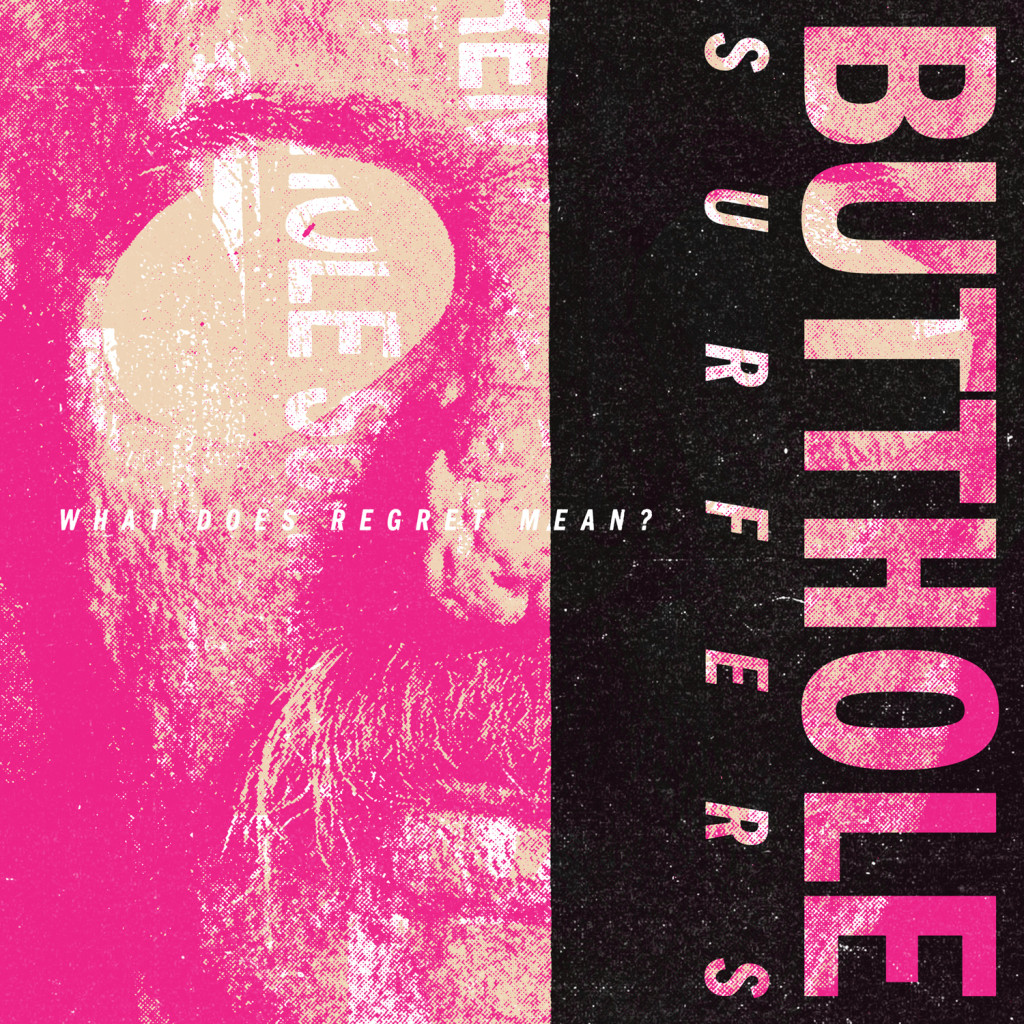
Butthole Surfers: What Does Regret Mean? – Aaron Tanner (2019)

            As a teenager, bored with hard rock and heavy metal for the most part, I sought out music that scared and excited and confused me because I was just so sick of the crap that MTV, radio, and the “norms” thought was good music.  I wanted the transgressive, the avant-garde, music that is so fresh and new and different that most people would hate it for years, until their feeble ears and brains could slowly catch up.  The first bands that sent me down this awesome spiral of skronk and freak-out were Jane’s Addiction and Sonic Youth.  Both were loud, rocking, and aggressive in completely different ways, and both sounded nothing like the formulaic heavy metal and thrash that had been rattling in my ears.  One band that was always mentioned alongside these two faves of mine was the Butthole Surfers.  

           My friends and I would drive into town in one of our parent’s cars on a Saturday and hit up the cool record stores.  At Sound Exchange, I would peruse the used cassette section, and every time I picked up one of the Butthole Surfers' albums, I would get a queasy feeling based purely on the visual aesthetic of their releases.  It was just SO WEIRD.  They did not list the band member’s names or song titles all that often, but what I did see is still burned into my mind.  I was too young and naĂŻve to understand that an artist’s image is mostly a fabrication.  I was also too young and naĂŻve to understand that the Butthole Surfer’s image was not in the least a fabrication, and that they were fully the weirdest single group of musicians I would ever have the fortune to listen to and love.

            Sometime in my first year of study at the University of Houston, my friend Barnaby Struve kept playing Butthole Surfers vinyl for me.  At one point he made me a 120 minute compilation cassette (remember when you could record 60 minutes of music on each side of a Memorex cassette?) of what he described as “the choice cuts.”  It was a revelation.  Even without any of the art, liner notes, or bizarre imagery, the music itself blew my teeny little mind.  I grew to LOVE these songs, to understand and relate to the insanity within, to see the undeniable beauty contained within, and to appreciate the balls it took for this band to stay true to their demented idea of themselves.  I played that cassette so many times.  I dubbed it for at least 5 different friends.  At parties, I would commandeer the stereo and play this Butthole Surfers compilation repeatedly (some people were not too happy about this).  The music was like instant intoxication, if that intoxication actually exposed the ugliest sides of ourselves.

            That was in 1991-1994.  The Butthole Surfers had been taking cares biz-nass since 1981.  Never during that time period would anyone even remotely aware of the Butthole Surfers consider that in 2019 a lavish, expensive, and downright beautiful coffee table art book would be released based mostly on the imagery the Butthole Surfers used in the promotional material, records, and merchandise.  Before the internet, the main way you found out about bands was from word-of-mouth, or lucking into seeing them as they opened up for someone you liked, or seeing a cool t-shirt on someone and striking up a conversation.  The Butthole Surfers were a band whose fandom grew in this manner, because everyone that witnessed a live show could not stop talking about it.  There was no other band like them.  There will never be another band like them.

            This book is like a deep time-slip dive into our collective Butthole Surfer past.  I cannot emphasize how often my shit-eating grin would appear on my face as I read this book.  Whether this was because of the many amazing images and fliers and promo materials, all presented like a DIY ‘zine, or because the commentary and remembrances sprinkled throughout brought me back to those times.  I was too young to see the Buttholes perform their insanity at small clubs in Texas, but I did get to see them perform many times, including at Lollapalooza where singer Gibby Haynes used a shotgun loaded with blanks to shoot at the crowd.  That shit was scary.  This book is scary.  The Butthole Surfers are scary.  They have to be.  I would not have it any other way.

            Aaron Tanner’s goal with this book was not to write a history, even though it is constructed sequentially.  He sought to share with the world just how individual and amazing the visual component of the Butthole Surfers’ myth was, from promo materials, to zines, to album notes, and personal photographs.  He has created something that I will treasure all the days of my life.  To top it all off, a flexi-disc is included with the book, containing a track that was to be used as a B-Side during the Independent Worm Saloon era.  Such cool stuff.  For a die-hard fanatic like myself, it is pure joy.

(BTW, I have played my wife 5 different Butthole Surfers songs over the past 8 or so years.  Each and every time she hears a new one, she tells me that it is "the single worst song she has ever heard."  This makes me laugh with glee and appreciation.)

(The Regular edition is sold out.  The Deluxe Edition is still available here: Melodic Virtue )

14.3.16

ANGER IS AN ENERGY! John Lydon tells it like it is.


Anger is an Energy – John Lydon, w/ Andrew Perry (2014)

            John Lydon, known by many as “Johnny Rotten,” was involved in two bands that helped set the stage and shape many of the forms of music that I grew up listening to.  His first band The Sex Pistols were like a bomb exploding in the world of music.  The effect is long-lasting, even though the band itself was very short-lived.  One official album recorded, a few years of existence, and it all went up in flames, perhaps for the best as their “manager” Malcolm McLaren was an incompetent business person with delusions of being accepted into the world of ass-sucking sycophants that is High Art.  The Sex Pistols inspired countless thousands of disaffected people worldwide, and still do to this day.  Lydon’s next band, Public Image Limited (PiL), was more experimental, more of an attempt at an actual band, and through their 30+ years of existence in some form or other helped influence many of the underground acts that eventually were lumped together into “alternative” music.  Whether it was the Pistols or PiL, John Lydon was always at the front, in full attack mode, ready to slay the stupidities of the world with caustic wit.

            I have always been a huge fan of people that tell it like it is, or at least how they see things to be.  I respect that.  I may not agree with them always, but I would much rather listen to someone espouse a deeply personal idea that they have thought about and arrived at and to which I disagree than to listen to someone so concerned about what offense people may take that they choose to play it safe always.  Nothing is more irritating than that!  Many of the most outspoken people I admired are dead now, (Lemmy Kilmister, Kurt Vonnegut, Hunter S, Thompson, George Carlin) and many more are smack dab into old age (Don Rickles, David Letterman).  There are not many people left out there in the entertainment world willing to really say what they feel. (Thank Mario for Steve Albini, still taking cares biznass)

            While I am not a big autobiography reader, I did want to get into this book because I like hearing things from the horse’s mouth, so to speak.  I had read or heard countless tales about John Lydon, and most were very unfavorable in a manner that made me think, “It is not him but those he angers that are actually unbearable.”  Reading about his childhood and growing up in dirt-poor England was very emotional, even though Lydon does not get sentimental at all.  It was emotional for me because so many people forget the truth about punk music, and they imagine it to be just another charade put on by record companies with no real bearing on actual living and dying.  Punk music was and is about something other than a genre or a musical sound/style.  Punk music was about bypassing other people’s ideas as to what makes a song “good” and instead doing what you think is good, and sharing it as equally viable and valuable.  You want to write a song?  Go write a song!  There are no rules.  Reading about the early days of the Pistols and the aftermath really shed light on how difficult it was to NOT be co-opted by the music machine, always on the hunt for the next money making gimmick.

            The fake punks, the posers, the hacks, they live and die for the gimmick.  They see a very narrow idea of what punk music is and then seek to emulate it to the exclusion of anything else.  This happened very early on and Lydon describes his feelings as he saw the very same narrow-mindedness and bigotry against anything different that he railed against on stage grow and destroy punk music from within.  He was indeed very angry and when he began Public Image Limited it was to be a team effort, crafting music they felt strongly about, with no regard for maintaining the same sound from record to record.  The early PiL albums are varied and “difficult” to listen to at first (unless you are already familiar with the many abrasive bands that were influenced by PiL), but they are very rewarding upon further re-listens.  This is the sign of well-made music.  Anything new will sound alien to one’s ear, but if it is quality, if it is honest, then its charms will grow on you and expose themselves, and you end up loving the damn thing more than you could ever think possible.  This happens with all music, whether it is Schoenberg’s atonal symphonies, Coltrane’s wall-of-notes hard-bop solos, Public Enemy and the Bomb Squad’s harshly abrasive mixes, or the cacophony of the PiL album Flowers For Romance.  This difficult music is always my favorite music.  (Hence my all-time favorite musical act, Sonic Youth, who even at their most melodic and temperate still utilize squalls of feedback drenched skronk to tickle my inner ear.)

            The chapters in “Anger is an Energy” are of two sorts.  Some are strictly chronological descriptions of the events as they happened, and others are feel more like John Lydon is directly talking to you laying out his personal feelings and ideas about life, music, the world, and his place in it.  These are my favorite chapters.  John Lydon is a very, very funny man.  I agree with him on so many specific things, and yet we could not be more different.  That is the beauty of thought.  It does not matter what your physical situation is, or who you claim to be.  Your mind and your thoughts are yours and yours alone and a true individual guards that with his life!  There is nothing more important!  It is a fight for your mind/soul that you are engaged in, whether you realize it or not.  There will always be someone telling you to shut up, telling your ideas are shit, telling you that you need to “know your place” and behave.  FUCK THEM.  John Lydon has lived that life as honestly as anyone can, and I love him for it.  

Towards the end of the book he details how the Rock N Roll Hall of Fame “inducted” the Sex Pistols, and how they realized it was all a pathetic co-opting attempt to emasculate the most in-your-face band.  Instead of shelling out thousands to fly people over and over $25,000 for a table at which to sit and watch the proceedings, they sent in a letter written by Lydon himself, and approved by the remaining band members.  It was everything I expected, and I respect the Pistols and Lydon even more because of it.  The full letter can be read here.
To their defense, the RnR HoF actually read this letter aloud during the ceremony.

This book taught me a lot about John Lydon’s life, the Sex Pistols, the creation and maturation of Public Image Limited, and gave me a great window into a man who the media chooses to portray as a pure anger cartoon.  Lydon is quite complex and interesting and I would love to meet him someday and listen to records with him.

(To read a sample from Anger is an Energy click here:  https://sample-88bc6515b3c71886b139f3cc1d45dbca.read.overdrive.com/?p=anger-is-an-e86ce7 )

(This book can be purchased here:  AMAZON  ) 

21.11.14

The rage, energy, and disenchantment that shocked the world with Punk Music had a long and nearly forgotten history


Lipstick Traces: A Secret History of the 20th Century – Greil Marcus (1989)

            I had read mentions of this book in various other ones I have read over the past few years.  I did not know if it was about rock and roll, or what, but I was very interested to read it.  I checked it out of the Library and devoured the damn thing over the course of a couple of weeks, reading while I ate my lunch at work.  I can honestly say that if I had tried reading this book when I was younger I would not have understood most of Mr. Marcus’ references.  I am glad I read it when I did!

            This book uses the jumping off point of the Sex Pistol’s short flash in the pan to delve into the history of aggressively nihilistic and bizarre art and social movements of the past, with a big focus on the work of the Dadaists, the Lettrists, the Situationists, and other nearly-forgotten fringe avant-garde art and literature groups of the 20th century, all of which Mr. Marcus feels informed the zeitgeist that brought about the Sex Pistols and that first wave of “punk music”, whether directly or indirectly or even by art osmosis!  Ha!  With countless notes and asides describing the goals and purposes of the freak movements in art, and with a great sense of humor and always with an eye to the truth inherent in the absurd, Mr. Marcus does a great job of shedding light on nearly forgotten intellectual anarchists.

            It is easy to think that the past is a stodgy trudge through boring facts and figures.  It is easy to think that seemingly modern outrages like Pussy Riot playing a guerrilla set of music in a Russian cathedral are new, but they are not.  Marcus describes how in the aftermath of the First World War French poets stormed Notre Dame on a holiday with the cathedral full of devout parishioners and began to announce that god was dead, only to barely escape out of there with their lives.  The connections that Marcus makes are not direct, but they are artistically direct.  The human society works with many strands of thought constantly weaving about one another, and to think that each generation had one sole thought or mentality is wrong on so many levels.  Every generation has its sensitive artists who are enraged at the travesty they see in society.  There is always something to rail against and sometimes the past is the best way to learn how to attack the future.  These “lipstick traces” amount to a much larger history than is normally accepted.  The Sex Pistols cry of “No Future” was just the latest in a long line of heartfelt cries of rage. 

RAGE!  FEAR!  LOATHING!

            This book would not have affected me as much if I did not already know of much of the art history being discussed.  It helps that I am a music lover and a punk rocker and have a passing familiarity with the underground thought that informs so much of the avant-garde.  This book is a great achievement and I am glad I finally read it!