Showing posts with label Brain. Show all posts

14.1.22

Francis Crick lays out the pathway to explore our Consciousness


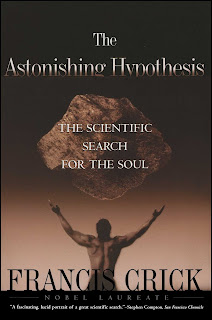
The Astonishing Hypothesis: The Scientific Search for the Soul – Francis Crick (1994)


            The title of his book is a bit misleading.  Francis Crick, one of the group of scientists responsible for our current knowledge about DNA, its structure, and how it works in living plants and animals, is not discussing what theology and religion call a “soul.”  What he seeks is the means and methods by which humans can empirically study consciousness/awareness itself.

            Consciousness is a very tricky subject for everyone involved.  Research scientists rarely explore consciousness itself, instead seeking to understand the physical workings of the brain.  Philosophers explore consciousness and awareness but do not use the knowledge derived from the decades of work done on physical brain structure, and the function of the many neurons in our brain.  This creates a vast gap of knowledge.  We know mostly how individual neurons work, and roughly how many areas of the brain correspond to different functions and cognitive abilities.  What we do not know includes what parts of the brain control or experience consciousness, exactly how we create and store memories, both short term and long term, and how we manage to process the myriad sensory inputs we constantly receive.  This book is Francis Crick’s attempt to survey the current state of things (as of 1994) while shining a light on many areas of research that could lead to fruitful answers, focusing mainly on visual Neuroscience.

            The “Amazing Hypothesis” in question is the proposition that what we call consciousness, and some call a “soul,” is a product of the way the brain’s neurons function, specifically the complex human brain, and that through empirical experimental methods we should be able to discover and understand the actual structure that brings about consciousness.  As the brain and all of human experience constitutes an exceedingly complex and varied system, it is best to try to study one specific aspect, hoping it sheds some light on the bigger picture.  Mr. Crick decides, based on the then-current state of scholarship, to focus on the specific ways we see, and how our brains process what we see.

            While many of the sciences have spent the past 100 years discovering deep truths about the world around us, this has not happened in the study of the human brain.  There are several reasons for this.  Firstly, it is considered unethical to conduct brain experiments on humans unless they have already suffered some sort of trauma/damage to their brain and willfully allow a scientist to experiment.  Secondly, the study of consciousness has been relegated to philosophers and theologians, most of whom know very little about the actual structure and function of the brain and its constituent parts.  This means that their explorations are more guesswork than deduction.  Thirdly, while we can study the brains of cats, rats, monkeys, or other lab animals, this does not necessarily translate to the human brain.  While a human being can be certain that they themselves are conscious, and be fairly certain that other humans around us are conscious, it is a much bigger jump to assume that other primates and animals share the same consciousness that we do.  A monkey is taught/trained to do certain tasks while their brain is monitored, but they cannot provide actual feedback like a human could.  Many scientists end up focusing solely on structure and the electrochemical reactions in the brain and not on what they mean for the study of consciousness.

            Francis Crick decides that in order to pick a specific area to research that is likely to provide the best answers to the consciousness question it is best to focus on sight.  How do we see?  How do our eyes, nerves, and brain work together to understand what is being seen?  This seems like a promising point of departure in the search for our consciousness.  Crick spends the first part of this book detailing the then-current state of scientific knowledge, exploring everything from studies on the eye’s retina, to the structure of neurons, to the many ways they communicate both within and without themselves.  One item that surprised me was the knowledge that many of the neurons that help the retina function act as a processing center, before the information reaches the brain itself.  In fact, the nerves that feed what your eyes see to the brain are part of the brain itself, not just a connection. It is as if neurons from the developing embryo brain reach out to connect to the developing eyes. Quite cool stuff.  What is also evident in the background info Mr. Crick provides is the vast amount we do not know.  We have very rough guesses as to what regions of the brain handle specific tasks.  We still do not know how exactly the brain regulates the massive sensory input it receives every moment of every day.  We have no idea how or where memories are stored.  This vast ignorance is actually a great thing for neuroscientists, as it helps guide them to new experiments and areas of research.

            The latter part of the book details many possible areas and studies that could be done to try and find the answers Mr. Crick looks for. Over a century ago it was common for educated people to believe that a Life Force flowed through living beings, separating them from the inanimate objects around them.  No other way could be imagined for the growth of the young, the way offspring look like their parents, etc.  Once we understood the cardiovascular system, the pulmonary system, and finally the structure, function, and purpose of DNA, the idea of a Life Force dissipated and was dropped by humanity as a whole.  Francis Crick thinks that is where we are at today in regards to the human “soul.”  Many blindly accept that it exists, especially in the forms that theologians and philosophers feel it does, but this could change were we to understand the workings of our brain.  We may find that consciousness is a direct result of life itself.  We may find that what we call consciousness is a trait shared by any and every creature with a neuronal brain, or we may find that only the human brain possesses the required structure to function as an individual consciousness.  The field is wide open and I cannot wait to read more.  It is nearly 30 years later and we still do not have answers to most of Francis Crick’s questions. 


2.8.18

Is Mind inherent in all of Existence? How can it not be?


Panpsychism in the West – David Skrbina (2017 Revised Edition)

      It has been almost 4 years since I first began posting reviews of the books I read on this blog, RXTT’s Book Journey.  One of the most gratifying and unexpected outcomes of this project has been the ability to correspond with some of the authors of the books I read.  It always thrills me when they reply to my communications.  One of the many who I have had a chance to correspond with has been mathematician, educator, and cyberpunk O.G. Rudy Rucker.  I always make sure to ask these authors if they can suggest any reading recommendations, and Rudy Rucker told me that this book, Panpsychism in the West, was one to check out, as he had recently enjoyed it very much.  The name David Skrbina was familiar to me based on various references to him and his writing in other books I read.  It was awesome to have such a great recommendation, and greatly appreciated.

      This book details the development, discussion, history, and possibilities of the philosophical idea called Panpsychism.  This idea suggests that the entity we call Mind is inherent in all of existence, and that this should affect everything about how we see ourselves, life, and the whole of existence.  Many of the Greek philosophers, who first pondered the reality of the world around us, our bodies, and our minds, came to the conclusion that Mind, consciousness itself, was an underlying part of everything that exists.  One of the arguments for this was that human beings feel they have a mind separate from the nuts-and-bolts physicality of their brain.  However, Humans are created from the very same stuff as everything else, and because of this our “Minds” cannot be a special occurrence.  Some form of “Mind” must exist in any and all life, and possibly into inanimate matter we deem to be not alive, perhaps even to the basic building blocks of matter.  They saw the human body as an aggregate of its many parts, and because of this, the parts themselves must have had some sort of “Mind”, just as the bigger systems around us, the atmosphere, the water cycle, the Earth itself, must also have a “Mind” constituent. 

      Later Greek philosophers would turn from this idea and head towards a mechanistic and non-spiritual perception of the Universe around us.  These ideas led to the Materialist universe in which modern humans exist.  We are told that the Mind is either purely a god-given trait solely found in Humans, or that the Mind sprang up only in Humans because we were the only ones to have a  complex enough nervous structure and brain to achieve this.  These human-centered objections to panpsychism have been put forth by philosophers and scientists throughout human history.  They only serve to point out the inherent bias among thinkers who ascribe all experience value based on their personal state, that of being a human on Earth.  They demean the experiences of animals, plants, and even rocks as purely mechanistic, even as they aggrandize the human experience.  This seems a contradiction to me. 

      Once the mechanistic worldview of Isaac Newton and classical physics began to influence the world, philosophers sought to discredit the idea of panpsychism by exclaiming that it was unscientific, in that there was no empirical way to test whether a rock or a tree has a Mind.  The blind-spot in their arguments is that, as of today, there is no way to empirically prove that a human has a Mind!  If it cannot be proven to exist in us, how can they be so sure it does not exist in the world around us?  Too many people run with this argument and fail to understand that panpsychism is not a scientific idea, but a philosophical one.  Empirical science can analyze a brain, the neurons and axions that make up the physical brain, and the various blood vessels that nourish and clean the brain, but they cannot in any way analyze the Mind.  Psychologists have tried, with varying degrees of failure, to analyze Mind as separate from the physical brain.  Psychiatrists try to utilize medicines and chemicals to force the physical brain into adjusting the process of the non-physical Mind.  It is a very confusing state of affairs.

      David Skrbina has done a great job of compiling not only the various supporting ideas and players throughout human western culture to discuss panpsychism, but also of the many philosophers and scientists who sought to deny panpsychism.  He explains how they came to their negations, and the ways in which they misunderstood the basic concept of panpsychism.  Many philosophers would push these ideas only to negate them later on in life.  Yet others, people who decried the possibility of panpsychism, came around in their later years and admitted that there is no way to discount the idea.  How their ideas went on to influence those that followed, and how the possibilities inherent in panpsychism would change the entire world-view of the whole of humanity is a focus of the later part of this book.

Philosophy as a field of study for me is very frustrating.  I find it hard to read the conclusions and assertions of philosophers whose base assumptions are inherently opposed to how I see the world around me.  It is very hard to argue with a dead philosopher!  I love to know the history of human thought and the development of our ideas on ourselves, but so much of it is purely fantasy, conceptualized reactions to embedded presumptions.  I feel that, as a basis of thoughtful exploration, it is much more valuable and realistic to assume that, just as we are part of the Universe, and have a level of awareness we call Mind, that every other constituent part of the Universe, both smaller and bigger than the cellular aggregate we call a human being also shares in this noetic quality.  It is impossible to draw a line of demarcation where Mind exists and then where it does not.  For example, we can say humans have Minds.  Many of us feel that our pet dogs and cats have their own Minds and personalities, independent of their physical being.  Is that the end?  Why wouldn’t smaller animals, such as mice or beetles or even amoebas, also share in this feature of existence we label a Mind?  If a one-celled organism can have a Mind, what about the single-cells that make up all living beings’ body structures?  If a cell can have a sliver of consciousness then what about the component parts of that cell?  Digging lower, what about the individual molecules and atoms?  What about the constituents of atoms?  No one can provide a definitive answer to where the line should be drawn.  Going bigger than humans, are larger aggregates like cities, mountains, oceans, planets, galaxies all possessed of a higher level of mind that we humans just cannot comprehend?  This book has given me quite a lot to think about.  It is highly recommended.

(The 2017 Revised edition of this book is available for purchase here: PANPSYCHISM IN THE WEST  )

14.7.17

If I Could Have the Nervous System of an Octopus, Without Its Many Arms...


Other Minds: The Octopus, The Sea, and the Deep Origins of Consciousness – Peter Godfrey-Smith (2006)

            Much of my reading, and many of the books reviewed here at the Intellectual Journey, deal in some way with the idea of consciousness.  Some books explore the relationship between the outside world and the “inner mind.”  Others seek to understand the raw organic material that our bodies are composed of and why it creates the entity we call Mind.  Still others describe the progress of our collective knowledge and myth-building, especially as they relate to human social constructs like religion and government.  It appears that the human capacity for consciousness and thought inspires many writers, scientists, and philosophers.  One of the great things about this book is that it takes a step back away from our human field of experience, to explore one of the few other animals on Earth that also has a highly complex neurological system, this being the octopus, and their cousins, the squid and the cuttlefish.

            Peter Godfrey-Smith began his journey to writing this book because he witnessed something that many other people who work with or near these amazing animals have noted.  They appear to be observing you, just as much as you are observing them!  They interact with humans, both in the wild and in captivity, like creatures that have some sort of self-consciousness, or sentience.  In the wild, an octopus will often reach out a single tentacle arm towards a human diver, to touch them and taste them (octopuses can sense chemicals with their skin, essentially being able to “smell” and “taste” anything they encounter).  A cuttlefish will often produce the most dramatic displays of color and light through its amazing skin, in a seeming effort to interact.   In captivity, there are countless stories of octopuses that can recognize individual humans in a group, even when they are all dressed exactly the same.  Other octopuses have learned to squirt water with their siphons at people standing outside their tanks.  A few have even learned that a squirt of water is handy in turning off the aquarium lights above their tanks.  They are masters of camouflage, mimicry, and contortion.  Because the largest “solid” part of an octopus is its eyes, it can squeeze through any hole that their eye will fit through, allowing a sixty pound octopus to escape captivity through a two inch hole.  Amazing!

            One of the coolest parts of this book details how the development of an amazing nervous system occurred separately in cephalopods than in primates.  The earliest common ancestor between cephalopods and humans lived very likely over 200 million years ago, back when all animal life was in the oceans.  From this animal a branching occurred, in one direction leading to the bilateral animals, including the ones with spines and bilateral symmetry and in the other branch, a path leading to the mollusks and eventually to the cephalopods studied in this book.  For us humans, much of our nervous system is encased in a hard shell (the skull) and this is the apparent seat of our conscious and unconscious thought.  Nervous signals are received from throughout the body and processed in the brain.  Cephalopods do not work in this manner.

            An octopus has nearly as many neurons as a human, but they are not localized in one certain area.  The octopus’ neural network is spread throughout their entire body, allowing them to have massive control over their shape, color, and skin texture.  Each arm of an octopus has its own functional node of neurons, essentially controlling the arm separately from the main “brain.”  These animals appear to have consciousness of a high order, but they do not have the same equipment as us humans.  In fact, in cuttlefish for instance, each individual neuron reaches from the skin to the brain node, without any other intervening connections.  Humans and most other animals do not work in this way.  We have sequences of neurons, each connected in linear form, to allow signals to travel from our finger to our brain and back.  This, while seemingly super-fast, actually slows down the signals considerably, as not only do electrical signals travel through the neuron, but chemical signals must be released and received in the connections between the neurons.  The octopus does not have this problem, and it’s sensory world must operate on a level that to a human would be unspeakably fast.  

            There is much discussion about the history of the study of sentience and consciousness, which is awesome, and provides a great background into the current state of thought on “thought” itself.  It helps the reader to understand the real differences between human consciousness and cephalopod consciousness, which is critical.  Humans have the ability to process in semantic layers, with some thoughts being submerged, others being lifted, and yet others trying to understand the thoughts being thought!  This creates a massively rich internal life in humans, and in other smart animals that have been studied, such as birds, dogs, dolphins, etc.  The octopus however lacks this inner life it seems.  What it does have is a nearly infinite ability to sense the world around it, to respond to it, and to explore it.  Our brains suit us, as we have a relatively long lifespan and a lot of information to learn as humans.  The octopus and most cephalopods live very short, brutal lives, sometimes not making it past a second year of life.  It did and does not need to store long term memory, to develop individual consciousness like humans.  It instead needs as much input from the world around it as it can get, in order to stay alive and procreate.

            I have always loved octopuses and cuttlefish.  I am so glad I found this cool book.  Peter Godfrey-Smith has given me quite a lot to think about as I continue on my Intellectual Journey.  I will for certain be reading more about the latest research on cephalopod intelligence.  As the writer states, meeting an octopus in its habitat is the closest we may get to meet a truly “alien” intelligence.

(This book can be purchased here: AMAZON  )

24.2.17

Sometimes the idea for a book is better than the finished product


Phantasmagoria: Spirit Visions, Metaphors, and Media into the Twenty-First Century – Marina Warner (2008)

            As an artist, I have always been interested in the way we humans perceive the world around us.  Most people take it for granted that what they see, hear, touch, etc. is corporeally real.  They assume that our brains are just receptacles, containers for the input our senses provide.  This is a very limited view of our minds.  Every single one of us is living in a world that exists solely in our minds, filtered by our personal experiences, beliefs, and prejudices.  Where some people see images in clouds, others never bother to look at all.  Our human culture, literature, and especially religion, has been reading into the visions of the mind since before we have record of it.  Marina Warner explores the many different ways that humans have tried to visualize the ephemeral.

            One thing that Ms. Warner does so well is to combine what appears to be a shit-ton of research and information into a concise accounting.  Each chapter describes human’s explorations into the meaning of ephemeral visions, such as clouds, shadows, fata morgana, mirror images, etc., from ancient times to the modern day.   This makes the book a very valuable resource from which to find other material that further explores the topics at hand.

            There is one big problem though.  I read such books to encounter new analysis and new insights into these subjects, as I am already well-versed with all these topics through my own personal research and reading.  This book does not have such analysis or thought.  After a few chapters it begins to read like a thesis by a graduate student, one that contains too many examples and too little substance.  Too many examples are cited with no context, just to pad out some of the thin chapters.  That is a shame.  I think a wonderful book could be written using this material, if it was more carefully edited and if it included more original insight.

(This book can be purchased here: https://www.amazon.com/Phantasmagoria-Visions-Metaphors-Twenty-first-Century/dp/0199299943 )

19.9.16

What Exactly Did the Ancient Mystics Experience, and Why?


The Cult of the Seer in the Ancient Middle East: A Contribution to Current Research on Hallucinations Drawn from Coptic and Other Texts – Violet MacDermot (1971)

            Sometimes I find myself drawn to read a reference work.  I really love reference materials, as they gather and explore a large amount of data into one cohesive book.  I have always enjoyed pouring information into my grey matter and seeing the connections made therein.  Having read quite a few books in the past two years dealing with the rise of worship, the human need for ritual, the neurophysiology of the human brain and how it affects what is called the mystical, and the development of mythology and the mythological basis for all of our religious belief systems, I figured that this book was indeed for me.  In this masterwork, Violet MacDermot has gathered together writings from the Egyptians, the Coptic Christians, the Gnostic Christians and the Hebrews, and seeks to understand the means by which these people enabled, experienced, and interpreted mystic visions/hallucinations.  It is an exhaustive book, and well worth going back to as a reference source.

            A book of this scope has many themes to explore.  One of the main ones is the change in mystical visions from the time of the Egyptian ascetics to the Hellenic/Greek times, to that of the early Hebrew mystics and then the Christian saints and martyr seers.  It explores the details of the ritual, religious life of an Egyptian believer, and then details how this differed from the life of the hermit mystic.  During and before the time of the Egyptian kingdoms, the role of ritual and religion was to help the individual understand their place in the larger scheme of things.  This included the general understanding that the divine was to be found in all things, both living and inanimate, and that to serve the greater community was the utmost goal.  The individual themselves is not of primal importance.  They are just a cog in the greater machine.  The gods depended upon the people’s rituals to ensure their endless cycles of birth, death, and rebirth.  Without strict regulations on rituals and religious services, the whole fabric of human society would have crumbled (in their eyes), and the legitimacy of their divine rulers (kings or pharaohs) would be devalued.  MacDermot provides countless examples translated from original source materials to show that the Egyptian devout felt their participation integral to the orderliness of the world around them.  The mystics at this time would do everything the opposite of what was expected from society.  They would remove themselves from the towns and cities, living alone in the deserts.  They would avoid the ritual prayers and ceremonies of the regular folk, and instead focus their whole energies into meditation, fasting, and the attempt to have the soul be rid completely of the trappings of the normal Egyptian world.  Because of this they found divinity in themselves, the full realization of it coming only very near death, as one lets go of this world and the soul moves onto the next.  Instead of ensuring proper mummification so that their body would be reunited with their soul in the afterlife, they sought a total wasting away, allowing their soul to unify with the divine and avoid the endless repetition of birth/death/rebirth.  This would prove to be very influential to the Hellenic, Hebrew, and Christian mystics who came after them.

            It seems that every new culture strives to erase the ideas of the past, or at least refute them.  The Greek philosophers did not agree with the Egyptian mystics.  They saw the world as a quite different place, and their mystical visions changed accordingly.  Many of them came to believe that the material world was one of pure degradation, always rotting, always in a state of decline, and that the spiritual world, the world of ideal forms and of the spirit, was one of perfection.  The Hellenic mystics would use many of the same techniques as the Egyptian mystics to bring about ecstatic visions.  Everything from fasting, to physical deprivation, to ritual dance, to chanting, to a secluded desert hermit life was utilized.  Their end goals were different though.  They did not come from a society that demanded everyone adhere to a specific set of ritual. Instead, they lived in a world where the philosophers told them that the divine/ideal was to be reached through pure thought, through philosophy, as it were.  They would meditate on the ideal, seeking to eliminate all thought of the base natural world from their minds.  Even though their aims were different, the visions described and experiences claimed were very similar to those of their predecessors in Egypt.  This continues on through the Hebrew and the early Christian mystical tradition.

            After the Egyptians and the Greeks, the mystics of the Hebrew and the early Christian faith were a bit different.  They did not see the world as divinity manifested (Egyptian) or as a shadow of the divine (Greeks), but instead they saw a strict duality of good versus evil.  Many tended to believe in the Manichean thought that the natural world is a wholly evil construct, one in which the body is purely a prison for the divine soul.  Because of this, any and all human activity was derided as either evil, or drawn from evil.  Of course, these activities were merely the residue of the earlier ages of religious thought.  Sex was evil, where before it was a personal experience of divinity.  Orgiastic feasts were evil, where before they allowed the community to share in the bounty that divinity had provided on the Earth.  To the mystic seers even the idea of organized religion was an evil, created on Earth to draw humans away from the truly divine, which could only be achieved by the total obliteration of the self, both physical and mental.  It really is insane how humanity creates its gods and means of worship, and then rails against it at a later time, only to then destroy and rail against the latest religious ideas.  

For modern Americans, a nice view from the balcony can be an ecstatic experience.

             If anything, books such as these that aggregate the religious literature over thousands of years and dozens of cultures go to show the deep schizophrenia that exists in the human mind when it is forced to believe something that is essentially a fairy tale explanation for the way the world appears to us.  Mystics to this day continue on with these self-mortification practices, starving themselves, ingesting hallucinogenic substances, enduring endless pain and discomfort, and separating themselves from the society at large, all to attempt to commune with a non-existent divinity.  So many people have died and suffered at the hands of those that believe their rituals are the true ones, and that any others must be stopped at any cost.  Currently there is a war going on in Islam, between different cults, each claiming they are the one true way to salvation and the divine.  The same thing goes on in Christianity, as the orthodox and the charismatic Pentecostals fight it out in the court of public opinion, as well as in our legislatures.  No one talks about this.  It is a hard subject to broach.  The more one learns about humanity’s religious history, the more one sees how it is all a very carefully constructed house of cards, ready to fall down at any moment, but taking up vast amounts of resources and time from millions of blindly faithful people that could be better served in the betterment of humanity at large.

            The best part of this book consists of the translations of source materials that Ms. MacDermot has gathered up.  It is quite amazing to see the literal plagiarism used to prop up the stories about saints and martyrs and mystics.  The people who wrote about the Christian martyrs used the writings about Hellenic mystics as source material, copying nearly every detail.  The Hellenic mystery cult writers did the same thing with the writings of the Egyptians.  So many things are accepted at face value because some learned wise man wrote it down thousands of years ago.  It is ridiculous.  Every new religion has to usurp the rituals and holidays of the ones that came before it, and by doing so, usually turn out to employ the exact same means that were deemed blasphemous or heretic.  The very early Christians followed the rules Jesus gave very strictly.  Jesus said to leave your family, to avoid sex, to not worship idols, to avoid working, to basically stop taking part in society and society’s rituals.  The Christian church however, created “sacraments” to ensure that the masses would still take care of their familial obligations, would still marry and have many children, would still pray to images of saints and martyrs, would still find employment to pay the 10% tithe required by the church, and would continue in their yearly rituals, disguised as Christian holidays (Easter = Ishtar, Christian Saint Feast days replacing those of previous religions, etc.).  In other words, the Church forced its followers to adhere to the very same things that their namesake, Jesus Christ, instructed them to avoid.  If that does not let you know it is all a crock of shit, then perhaps you should read this book and start the exploration for yourself.

(This book is out of print but can be purchased used here: AMAZON  )